
Bed Bath & Beyond on the Brink of Bankruptcy: How Did the Former Home Goods Giant Get Here?
Bed Bath & Beyond is facing bankruptcy risk. The seemingly successful transformation in 2020 collapsed within two years: net sales fell by 25%, CEO Tritton departed, and the credit rating was downgraded to CCC. This article analyzes its long-term problems, transformation missteps, management decisions, and market challenges, and explores possible future directions.
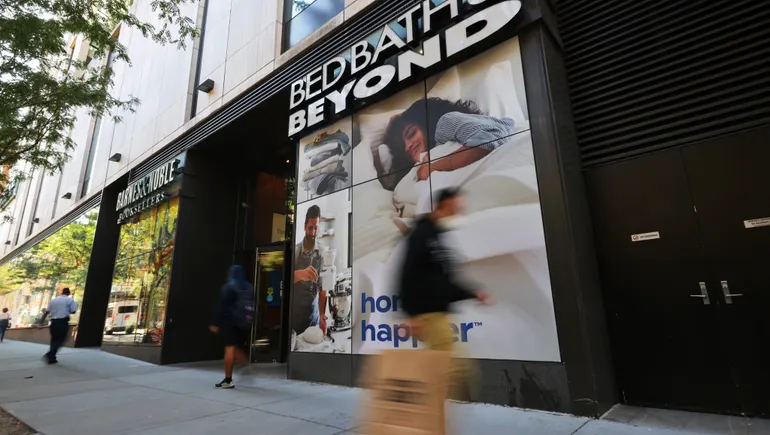
In 2020, Bed Bath & Beyond's turnaround efforts seemed to be on track: store renovations, launch of private brands, restructuring of the executive team, and divestiture of underperforming business segments. Like other home goods retailers, the company was also boosted by strong consumer demand for new home products in the early days of the pandemic.
Under the leadership of Target veteran Mark Tritton, Bed Bath & Beyond was once viewed favorably. However, the latest quarterly earnings report shows that the company's net sales decreased by 25% year-over-year, comparable sales decreased by 23%, operating losses expanded by more than $265 million, and net losses increased by more than $300 million.
Tritton—who had helped with Target's transformation—and Chief Merchandising Officer Joe Hartsig both left at the end of June. GlobalData Managing Director Neil Saunders said: "The transformation has failed, and the business is in such a bad state, with sales and profitability severely declining. His departure was inevitable, both because his initiatives were ineffective and because investors were increasingly losing confidence in his strategic direction. I don't think this is a positive signal for Bed Bath & Beyond."
Now, Bed Bath & Beyond faces a high risk of default, and experts predict the company may file for bankruptcy or be acquired in a privatization deal within the next 12 months. S&P Global Ratings downgraded its rating to CCC on Monday, noting that the company could default on its debt or undergo restructuring if turnaround efforts do not show significant progress. According to Bloomberg News last week, the company also hired Kirkland & Ellis, a law firm specializing in restructuring, to assist with its debt—the same firm that helped retailers like Toys R Us, J.C. Penney, and Neiman Marcus through Chapter 11 bankruptcy proceedings.
So, how did Bed Bath & Beyond get to this point? Why did it fail to seize the opportunity of rising demand?
Long-standing chronic problems
Bed Bath & Beyond's problems existed long before Tritton became CEO at the end of 2019. In the spring of 2019, following an activist investor campaign, the company's board underwent restructuring, and co-founders Warren Eisenberg and Leonard Feinstein stepped down from the board. In May of that year, then-CEO Steven Temares left at the request of activist investors.
The company's financial condition was already weak at that time. Data provided by RapidRatings to Retail Dive shows that between 2018 and 2019, Bed Bath & Beyond's default risk rose from low to medium. Wedbush analyst Seth Basham said: "The company was in a state of decline, losing its customer base, with declining foot traffic and a weak omnichannel platform."
Basham noted that after Tritton took office in the fall of 2019, he "did do some right things to stabilize the situation," including expanding online purchase with in-store pickup and curbside pickup services. "But he also happened to be in the pre-pandemic period and was able to benefit from some of the pandemic demand."
Missteps in the transformation
Although restoring foot traffic and market share was imperative, Tritton's transformation plan had many missteps. Saunders analyzed: "Interestingly, his plan didn't look wrong on the surface; it sounded logical and reasonable. But the problem was that he was too aggressive, tearing up the old playbook overnight and directly applying Target's successful strategies, while ignoring whether Bed Bath & Beyond customers actually needed these things."
The new initiatives alienated a large number of core customers but failed to attract enough new ones. Saunders added: "The strategy itself may not have been wrong, but the execution was highly inappropriate."
The surge in sales in the early pandemic period gave management a false impression of improvement. Basham said: "They were overly optimistic, attributing the improvement to internal changes rather than market trends. Over the past 18 months or so, they have continued to lose market share. Once market growth slows, this will become a major problem. The market strength is not sustainable, and they clearly misjudged the market outlook. This year, Mark expected the market to continue growing, but it has declined sharply in recent months."
According to research provided by 1010data to Retail Dive, from early 2020 to early 2022, growth in the overall home category declined by 10.8%, with kitchen, bedroom, and multi-room items seeing the largest declines. Jonah Ellin, Chief Product Officer at 1010data, said in an email comment: "As the economy reopened, inflation intensified, and travel spending opportunities reappeared, growth has slowed significantly."
The private brand strategy was also problematic. The company planned to increase private brand penetration from 10% to 30% and announced in the fall of 2020 that it would launch more than 10 private brands within a year and a half. Starting in early 2021, Bed Bath & Beyond launched brands such as Nestwell, Simply Essential, and Wild Sage, and relaunched Haven. But Saunders believes these brands were lackluster: "Some private brands were of poor quality, with high return rates, pricing that didn't match quality, insufficient differentiation, and were just simple white-labeling. People say private brands are a good strategy, and indeed they are, but only if executed well."
The company reportedly discontinued Wild Sage about a year after its launch. Additionally, its merchandising strategy included removing thousands of underperforming SKUs from national brands to eliminate the cluttered store image. But the strategy may have overcorrected. Saunders described: "Now when you walk into a Bed Bath & Beyond, the store is bland and lacks character. Before, there was at least some sense of surprise, like treasure hunting. Now it's just beige and very dull."
This shift shocked consumers because national brands have higher recognition and deeper emotional connections with consumers. Basham pointed out: "They made mistakes in the pace and planning of the merchandise transition, replacing national brands with private brands too aggressively in the short term, while the latter are less trusted by consumers."
When the supply chain crisis hit the retail industry, over-reliance on private brands while cutting national brands led to out-of-stock issues. Basham noted that private brands are mostly shipped from overseas locations such as Asia, with much longer lead times compared to national brands that typically have inventory in the U.S.
Over the past few years, competition in the home industry has intensified, with retailers with more capital and resources such as Target, Walmart, and Amazon gaining share during the pandemic. RapidRatings CEO James Gellert said: "Consumers tend to prefer one-stop shopping, and online they are more loyal to Amazon and Walmart's membership programs than to Bed Bath & Beyond."
Meanwhile, areas that could have been differentiators, such as the wedding registry business, were neglected. Saunders criticized: "The store is piled with old inventory and boxes, and a few chairs look like they're from a DMV waiting room. Think about it—is this the place people want to plan an important moment in their lives? It shows a lack of thought, execution, and care for customers."
Management issues
Macroeconomic factors such as the fading pandemic demand and supply chain challenges are certainly unfavorable, but they don't explain the whole story. As of May 28, the company had approximately $1.4 billion in long-term debt. But last November, Bed Bath & Beyond announced it would accelerate the completion of its $1 billion share repurchase program, having already bought back $600 million, and planned to complete the remaining $400 million within the fiscal year. Gellert called this "a very self-indulgent act for a company with operational difficulties."
Saunders said bluntly: "Bed Bath & Beyond spent a huge amount on share buybacks, which was by no means wise, especially with the balance sheet already flashing red. It was just to appease investors, and the result was only to leave the company in a weaker position."
RapidRatings data shows that from the first quarter of fiscal 2022 to the first quarter of fiscal 2023, the company's financial health score (measuring the probability of default within 12 months) plummeted from 68 (low risk) to 28 (high risk). Its core health score (measuring medium- to long-term sustainability and operational efficiency) is currently 30 (poor). Gellert said: "A drop of 40 points, while not unprecedented, is difficult for any company that is even somewhat healthy. What worries me most is that its losses and cash burn are not marginal changes but exponential deterioration. They are in deep trouble."
With the assistance of Kirkland & Ellis, restructuring could include new loans, refinancing, or both. Despite the recent decline in home demand, other companies in the industry are performing better than Bed Bath & Beyond. Saunders noted that other retailers "still maintain some momentum in the current period, far from the customer attrition and sales decline seen at Bed Bath & Beyond."
Worse, consumers facing inflationary pressures and economic uncertainty are cutting back on discretionary spending, which adds another blow to Bed Bath & Beyond's future prospects. Tim Derr, partner in Kearney's consumer products practice, said: "People are tightening their wallets, and consumer behavior is under pressure. Especially given the potential recession (some believe we are already in one), they will be more cautious about optional spending such as investments in the home."
The company's deteriorating business and failed transformation have attracted the attention of activist investors, especially Chewy founder Ryan Cohen. Cohen, who previously took a stake in GameStop and served as chairman, bought shares in Bed Bath & Beyond earlier this year and criticized Tritton's transformation plan as "piecemeal." In a letter to the board in March, Cohen wrote: "From our perspective, Bed Bath's strategy looks much better in PowerPoint than in practice."
Cohen called for the sale of the BuyBuy Baby business or even the entire company. At the end of March, Cohen and his fund RC Ventures reached a cooperation agreement with the company, adding three new directors and establishing a group to "explore alternatives to unlock greater value." However, Cohen's investment company announced on Tuesday that it would sell its approximately 11.8% stake in the company (purchased between January and March of this year). Despite Cohen's exit, he has successfully driven change. Saunders said: "He put enormous pressure on the company."
Given the company's financial condition, Saunders believes selling the baby business is likely necessary. Gellert expects that without a major financial event (bankruptcy or sale), Bed Bath & Beyond will struggle to survive the next 12 months. CreditRiskMonitor's FRISK score (measuring the probability of bankruptcy within one year for public companies) is 1, corresponding to a bankruptcy probability of 9.99% to 50%. Gellert asserted: "Given its lack of cash relative to needs, I expect that within a year they will either consider bankruptcy or be taken private. I don't think they will exist in their current form after 12 months."
What lies ahead
With the CEO position vacant and financial condition deteriorating, Bed Bath & Beyond urgently needs to address multiple issues: stabilize finances (possibly including selling BuyBuy Baby), fix the supply chain, and reassess its customer value proposition. Basham said: "They must find ways to attract customers to stores and online, and convert traffic into sales. The value proposition urgently needs improvement."
Saunders believes that when searching for a new leader, the company should prioritize candidates with deep operational experience and turnaround capabilities, rather than someone like Tritton who focused excessively on branding while neglecting operational fundamentals. He said: "There is always hope for a company, but unless Bed Bath & Beyond can come up with a truly clever move, the prospects are slim."
Editor's note: This report has been updated to include S&P Global Ratings' latest rating information for the company.