
Yeezy is just one of Adidas's problems: the retailer's gap with Nike has continued to widen over the years
The revenue gap between Adidas and Nike has widened from about $5 billion to $20 billion over a decade. In addition to ending its partnership with Kanye West, Adidas faces multiple challenges including stagnant sales growth, a weak North American market, and ineffective celebrity collaborations. New CEO Bjørn Gulden is trying to turn things around.
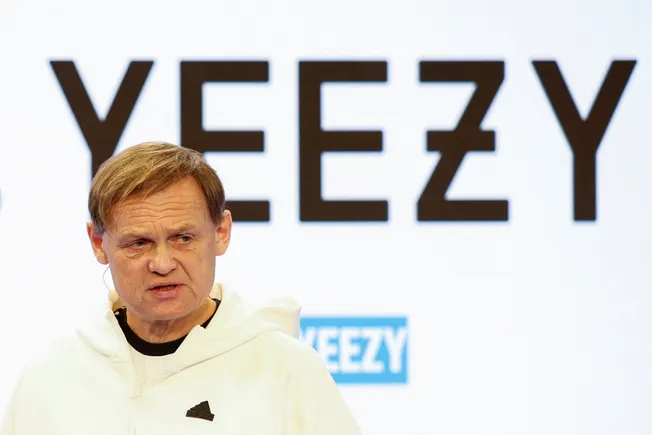
In 2013, Adidas partnered with Kanye West for the first time. At that time, the sporting goods giant was still within catching distance of competitor Nike. That year, Adidas's revenue was 14.2 billion euros (about 19 billion US dollars), trailing Nike's 25 billion US dollars, but far from the current gap of about 20 billion US dollars between the two.
A decade later, Adidas's net sales have grown by less than 5 billion US dollars, the brand is facing its first annual loss in thirty years, and its partnership with Yeezy has ended, leaving a large amount of inventory for sale, with a promise to donate a significant portion of sales proceeds to charity.
Wedbush analyst Tom Nikic said: "I think the Kanye West situation was initially the right time, right place, right person, but it ultimately evolved into a very wrong person issue."
In October 2022, Adidas decided to part ways with the celebrity known as Ye, following a series of anti-Semitic remarks and a record of multiple inappropriate behaviors. As a result of this decision, Adidas lost 600 million euros in fourth-quarter revenue, and the company warned that it could lose up to 1.2 billion euros in 2023 if it did not sell the remaining inventory.
Barbara Kahn, a marketing professor at the Wharton School of the University of Pennsylvania, said of the Yeezy inventory: "I've never seen something become so instantly tainted like this; it's almost unprecedented."
The decision to sell part of the inventory came after months of discussion, during which alternatives such as burning the merchandise were considered. Ultimately, CEO Bjørn Gulden, who took office in January, said that selling was the preferred choice of employees, consumers, and other stakeholders. So far, early signs show that the remaining products are selling well. The Financial Times reported that Adidas received orders for its first batch of Yeezy merchandise worth more than 500 million US dollars, exceeding expectations, with some orders unfulfilled.
Even with a way out for the tainted Yeezy merchandise, Adidas still shows signs of a brand losing its way. According to the Wall Street Journal, the partnership with singer Beyoncé fell apart earlier this year, after Ivy Park sales dropped more than 50% in 2022. The company completed the sale of the Reebok brand in 2022, after years of poor performance. Adidas also replaced CEO Kasper Rorsted months ahead of schedule. Additionally, Adidas's 2022 sales were lower than four years earlier.
Kahn noted: "Lululemon is doing well, Nike is also good—so the problem isn't the category itself. Their difficulties are not due to the category."
How exactly did Adidas, which was sailing smoothly eight years ago, end up where it is today?
"We've been waiting a long time for Adidas's next hit product"
Although Adidas has long been the second-largest sporting goods company behind Nike, the revenue gap between the two has widened rapidly over the past decade, as Adidas's sales growth slowed. Except for 2021, a rebound year after the heavy impact of the COVID-19 pandemic, Adidas has not achieved double-digit sales growth since 2017.
That year, the retailer was at its peak: sales grew 10% in 2015, 18% in 2016, and 16% in 2017, before slowing noticeably the following year. These results came when the Superstar series was shining in the US market—a shoe originally designed as a basketball shoe, now a classic lifestyle sneaker for Adidas.
Matt Powell, a consultant at retail consulting firm Spurwink River, recalled: "The Superstar was the number one selling shoe in the US at the time, something Adidas had never achieved before. During the period when the Superstar truly took off, they gained a lot of market share. And when the Superstar craze faded, they gave back a lot of share."
Nikic believes Adidas had other highlights during that period: the Stan Smith performed well, and the Ultraboost launched, both contributing to the sales surge.
Nikic said: "The Ultraboost was released a long time ago—since then, there hasn't been much that makes you say, 'This looks like Adidas's next hit.' We've been waiting a long time for Adidas's next hit. That's exactly what they need: to find something that drives brand heat, making people walk into Foot Locker or Dick's Sporting Goods and leave with a pair of Adidas instead of Nike."
When discussing Adidas's growth period, it's impossible to ignore Yeezy. In an earnings call in early 2016, then-CEO Herbert Hainer praised the company's "unparalleled presence" in the lifestyle segment, saying "every generation of Yeezy Boost is writing one success story after another."
According to the Seeking Alpha call transcript, Hainer specifically mentioned the Yeezy Boost 350, which won Footwear News' Shoe of the Year award. Hainer said: "There's no doubt that the collaboration with Kanye West has significantly enhanced our brand image, not only in the US, but especially in the US."
In fact, the scale of Adidas's partnership with West has few rivals in sports retail. Puma signed Rihanna in 2014 and recently announced a renewed collaboration with the popular artist. Powell said Rihanna brought a "clear boost" to Puma's business when she joined. But her departure's impact was far less than West's departure from Adidas.
Nikic said: "If you could get in a time machine and ask Adidas people... 'How big do you think Yeezy can get?' I guess they wouldn't have thought it could become such a big brand eventually. It's almost unprecedented. The only other collaboration of similar scale you can think of is Michael Jordan. Jordan Brand is bigger than Yeezy, but... such collaborations usually don't generate this kind of attention, heat, or even sales and profits. Indeed, there are almost no other comparable examples in history."
"Without a broader consumer base, there's no business"
The end of the Yeezy partnership is perhaps the most obvious signal of Adidas's current state. The retailer was tied to a celebrity who, as Kahn put it, "kept signaling an unstable personality," and may have bet too heavily on this collaboration from the start. Unlike some other brand ambassador scandals, this one was hard to ignore.
Tim Derdenger, associate professor of marketing and strategy at Carnegie Mellon University, has studied the impact of brand ambassador partnerships on retailers. In a study on the effect of Tiger Woods's infidelity scandal on Nike golf sales, Derdenger found that after the scandal, Woods's prestige effect on customers was "quite significantly" diminished. But although customers avoided Woods himself, they were still drawn to his athletic ability as the world's top golfer—the "signal effect."
"This is a big country; people focus too much on these small things happening in Brooklyn, thinking they'll affect the world, but they won't."
Derdenger said: "Having the world's number one player use your ball, your equipment, wear your clothes is still valuable to Nike." But the Yeezy situation is different. "We all know what Kanye said. The impact of his behavior and remarks eroded the core elements Adidas relied on to drive sales... And unlike Tiger Woods, Kanye has no signal effect."
Adidas's partnership with Beyoncé is different—she is one of the most famous artists of her generation, but reportedly the Ivy Park line still failed to meet Adidas's expectations. Adidas did not respond to requests for comment about the end of its partnership with Beyoncé and Ivy Park's performance.
Derdenger said: "There's no scandal; it's Beyoncé: she has appeal, prestige, people want to buy her stuff. The only explanation is that the demand isn't there. The next question is, why isn't the demand there? It's not because Beyoncé did something like Kanye. Maybe it's that the consumer group Ivy Park and Adidas were trying to attract doesn't have a good market fit for this type of apparel."
In Powell's view, Adidas's marketing strategy is also too skewed toward collaborations. The sporting goods giant launched a "staggering number of collabs" that gained widespread attention on social media and sold out within minutes, but usually in small quantities. Without effectively commercializing collaborations to reach a broader audience, Adidas is wasting time and resources on relatively low sales volumes.
Powell said: "Developing a collab of 5,000 pairs takes the same effort as developing one of 500,000 pairs. If you put all your effort into small collabs and don't fix the big product engine, you'll be in trouble. Without a broader consumer base, there's no business. This is a big country; people focus too much on these small things happening in Brooklyn, thinking they'll affect the world, but they won't."
In an interview with Gulden in Adidas's 2022 annual report, the executive praised collaborations with companies like Gucci and Prada, but said the company wasn't promoting its collaborations enough.
Gulden said: "I believe if given some time, we can—and will—turn this into a very successful model. Again, we just need to work harder on the basics."
Another issue may be that the company's strategy is too Europe-centric. Adidas has a strong roster of soccer players, which helps in global markets, but in the US, basketball is more important. And competitor Nike has what Nikic calls a "stranglehold" on basketball. This weakness in the US sports scene has led to a nearly 12 billion US dollar gap in North American sales between Adidas and Nike.
Although Nike generates higher revenue than Adidas in every region, North America is where the gap is largest. The 12 billion US dollar gap in that region exceeds the combined gap of all other regions and accounts for more than half of the total revenue difference between Nike and Adidas.
Explaining why Adidas struggles in the North American market, Powell said: "They've always approached the US market with a very Europe-centric view."
He added that over the years, the company's US wholesale partners have been "begging the European side for more products truly designed and made for the US market, not the European market. It may sound like a nuance, but it's actually quite different."
Gulden may already be addressing this challenge and more as he takes the helm at Adidas. But is the worst over?
"You can't replace Yeezy"
Gulden has lowered expectations for 2023, emphasizing that it will be a transition year, and he acknowledged that Adidas "has not performed as it should." The most pressing question for observers is whether this year will mark the end of Adidas's downward trajectory.
Nikic said: "You could say the deck is now clear, right? Reebok was a long-term problem child—now it's no longer their problem. Kanye West was good for them for a long time, then became a problem—now he's no longer a problem either."
Former CEO Rorsted has also been replaced, ending a period that focused more on operations than product development. Some of Adidas's problems are also self-inflicted, including merchandise that failed to resonate with the market.
Gulden joined from Puma, where he led the brand in developing attractive merchandise and signing high-profile brand ambassadors, and he has prior experience at Adidas. Analysts say that with such a leader at the helm, Adidas may begin to reverse these trends and potentially return to growth.
Currently, the retailer is stalled. Even accounting for the sale of Reebok (which reduced Adidas's net sales by about 2 billion US dollars), the retailer has underperformed the rest of the industry.
Nikic said: "Ultimately, seeing Adidas's revenue basically flat for five or six years while Nike and Lululemon—and smaller players like Hoka and On Running—all grew significantly is quite shocking. It says something about how off their game they've been."
Getting back on track may require moving away from Adidas's more fashion-oriented positioning and returning to its core: selling sports products. Nikic noted that in some markets, like China, Adidas's brand positioning leads consumers to buy its apparel for everyday wear, while turning to competitors when they need sports gear. Kahn noted that this perception is not ideal for a global sports brand and exposes Adidas to the volatility faced by fashion brands.
Powell said that in the Chinese market, Adidas especially faces competition from local brands rising amid strong anti-Western sentiment. Repairing its image and sales in that region could be key to growth. Gulden seems aware of the brand's regional challenges and the importance of reversing these trends. In the company's annual report, he said he plans to bring "localized focus" to each region, rather than relying solely on global products and celebrities.
Gulden said: "Demand in China may differ from Germany or North America. This localized focus on giving consumers what they need must be a priority. That said, as our home market, we should be the market leader in Europe. We also know that if we don't succeed in North America, we're not truly a global brand. China has always been our growth driver. But due to the pandemic and other challenges, we're not what we used to be."
Powell believes that if Gulden gives Adidas's operating regions more autonomy, especially the US market, the company could begin to turn things around by 2025.
As for replacing Yeezy: "You can't replace Yeezy," Powell said. "You can't achieve that scale of business with any other celebrity."
Signing star athletes to add credibility to the Adidas brand remains important, but it can't fill the gap in brand ambassadors. Betting on pop culture influencers—like the company's recent launch of its first new line in 50 years with Wednesday star Jenna Ortega—is a riskier strategy.
Kahn said: "This is clearly high risk, high reward, because you're putting a lot of bets on a hot figure. Historically, brands often tie themselves to popular celebrities... so it's not unusual." But having the actress at the core of the company's first new line in 50 years is "a bit surprising," she said.
Perhaps more importantly, the collapse of the Yeezy partnership gives Adidas a unique opportunity. Despite the short-term pain, Adidas has the chance to rethink what the brand stands for, its values, and its future direction.
Kahn said: "If they just treat this as a nuisance, I think they're missing an opportunity for brand reinvention."
