
Will retailers retreat due to 'woke' culture?
This Pride Month, retailers face intense backlash from the far right. Belk canceled a drag show and removed children's Pride clothing, while Target pulled some items. Experts believe this tests companies' diversity commitments and advise firms to uphold human rights values rather than yield to the loudest opposition.
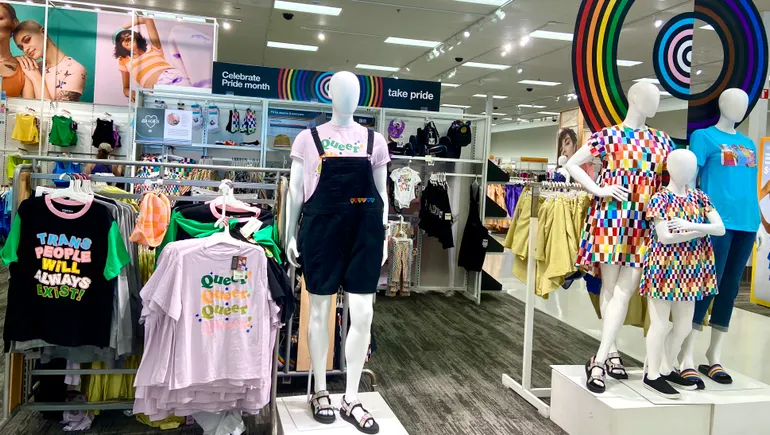
This year's Pride Month got off to a rocky start, especially for retailers trying to celebrate the occasion.
Recently, Belk department store in Charlotte, North Carolina, reportedly canceled its traditional drag show just before the event was set to begin. Just days earlier, the department store had stopped selling its children's Pride collection. Belk did not respond to requests for comment regarding its decisions on Pride events and merchandise.
In late May, just ahead of Pride Month, protests over Pride merchandise at Target stores prompted the retailer to adjust its displays. About a month earlier, Bud Light's partnership with a transgender influencer sparked right-wing anger, leading its parent company, Anheuser-Busch, to put the executives responsible for the marketing campaign on temporary leave.
Experts say this wave of backlash stems from the far right and is a test of corporate diversity efforts, values, and marketing strategies. For years prior, retailers and brands had celebrated Pride Month without much trouble.
"The tide we're facing is not social change," said Bob Witeck, president of Witeck Communications, who has worked on LGBTQ+ communications strategies and market research for 30 years. "It's inspired and fueled by individuals and media influencers who are determined to attack everything 'woke,' everything left-wing and LGBTQ+, especially transgender people."
'Get woke, go broke'
The term 'woke' has recently come under fierce attack.
According to Yale professor and novelist Stephen Carter, who served as a clerk for U.S. Supreme Court Justice Thurgood Marshall, for much of the 20th century, the term 'woke' was used by labor activists and Black communities to urge people to stay alert and not fall prey to those who would exploit them.
In 1962, novelist William Melvin Kelley, in a New York Times article about Black and Beat Generation slang, described 'woke' as 'well-informed' and 'up-to-date.' In the 21st century, after the police shooting of Michael Brown in Ferguson, Missouri, in 2014, the word was imbued with renewed political urgency. Today, Merriam-Webster defines it as 'aware of and actively attentive to important societal facts and issues (especially issues of racial and social justice).'
Some right-wing commentators and politicians have seized on the term, using it to mock companies and individuals who defend the rights of marginalized groups. The dictionary notes the word can be used in a 'disapproving' sense, and Republican presidential candidate and Florida Governor Ron DeSantis, who favors right-wing terminology and related legislation, has become a standard-bearer. In a speech in Iowa on June 3, he used the term seven times in 26 seconds.
The phrase 'Get woke, go broke' has thrived on social media, often cited by those cheering the alleged stock declines of Bud Light and Target after boycotts. But the war over words is not over. According to Global Strategy Group, groups like Consumers' Research—once led by M. Stanton Evans, a defender of Joe McCarthy—are also working to turn 'woke' and 'ESG' (environmental, social, and governance) initiatives into 'dirty words.' DeSantis has also linked the two.
In this context, Global Strategy Group, a Democratic polling firm advising private companies on reputation initiatives and social impact, recommends clients avoid the term 'ESG' and instead discuss 'issues that drive social change.' But according to Alison Taylor, executive director of the Ethical Systems project at NYU Stern School of Business, companies embrace ESG initiatives because they help meet regulatory, investor, and consumer demands. She said by phone that these efforts would be useless if a company only listens to the loudest voices in the room.
"In this contentious world, the only realistic foundation for corporate values is human rights, and your commitment to human rights, dignity, free speech, bodily autonomy, and so on," she said. "If you respond to everyone who yells at you and try to keep your head down, you lose your moral footing. You can't take a middle position on segregation. You can't take a middle position on civil rights. In a polarized environment, if you face a boycott, you need to clarify your values and stick to them."
Going to extremes
It remains unclear whether consumers boycotting companies like Target, or even some politicians attacking the 'woke' trend, fully understand who is fueling their anger.
When videos of people destroying Pride merchandise inside Target stores went viral online, Kimberly Fletcher, founder of Moms For America, sent a statement to reporters saying, 'Moms will not tolerate sexualized marketing targeting our children, nor the imposition of radical far-left propaganda on them.' The group describes itself as 'a national network of hundreds of thousands of moms' with a 'mission to empower moms to raise patriots and promote freedom for the healing of America.' However, the Southern Poverty Law Center, which monitors hate crimes and extremist activities including the KKK, neo-Nazi movements, and anti-government militias, has listed Moms For America and several of its state chapters as hate groups.
On the day before the January 6, 2021, attack on the U.S. Capitol, Moms For America organized a protest in Washington against the 2020 election. Fletcher herself repeatedly invoked the Fifth Amendment when questioned by the House select committee investigating the riot. According to watchdog groups, since January 6, extremist groups have prioritized culture wars, focusing attacks on the LGBTQ+ community. According to the Armed Conflict Location & Event Data Project (ACLED), as of last November, anti-LGBTQ+ activities by far-right militias and radical social groups like the Proud Boys had more than tripled compared to 2021.
In some areas, disruptions at Target stores even escalated to bomb threats linked to the Pride Month turmoil, though they were ultimately deemed not credible.
Threats also come from the legislative level. According to the Anti-Defamation League, at the Conservative Political Action Conference in March, 'anti-transgender hate was placed at the top of the agenda.' The organization, founded in the early 20th century to combat anti-Semitism, now researches and acts against various forms of extremism. With more than 75 anti-LGBTQ+ bills signed into law this year—more than double last year's number—the 40-year-old LGBTQ+ advocacy group Human Rights Campaign declared a 'state of emergency' for the first time on June 6 to help ensure the safety of LGBTQ+ people.
"The escalating threats facing millions in our community are not just perceived—they are real, tangible, and dangerous," said Kelley Robinson, president of the Human Rights Campaign, in a statement. "In many cases, these threats are leading to violence against LGBTQ+ people, forcing families to flee to safer states, and fueling a rising wave of homophobia and transphobia that puts everyone's safety at risk."
According to New York Attorney General Letitia James, retailers' defensive moves against anti-Pride backlash have consequences for both the community and the retailers themselves. On Wednesday, James said she had sent a letter co-signed by 14 New York City and state lawmakers urging Target CEO Brian Cornell to reconsider the decision to pull Pride merchandise. Target declined to comment on the letter, reiterating only its initial statement from May 24.
Target's decision to pull some Pride merchandise in response to boycotts from anti-LGBTQ+ customers is wrong. Hate and bigotry cannot win: New York's elected officials and I are urging Target to reverse its decision and stand up for LGBTQ+ rights.
— NY AG James (@NewYorkStateAG) June 14, 2023
"When fringe beliefs and antisocial behavior are used to coerce one of America's largest general merchandise retailers, it discourages the broader business community from standing with the LGBTQ+ community," James wrote. "It also shows that Target and other companies may retreat from efforts to promote diversity, equity, and inclusion under pressure. Target has long championed these values, and it is painful to see your company seemingly intimidated into turning away from them."
She added: "We urge Target to demonstrate your long-term commitment to investing in and supporting the LGBTQ+ community by putting all Pride-related merchandise back on shelves and taking strong measures to ensure employee safety."
Out of step
Experts say the capitulation seen in companies like Bud Light and Target runs counter to the policies they advocate internally and externally, as well as the values held by most American consumers.
For example, Target calls inclusivity a 'core value' on its website under 'Sustainability and ESG' and 'Diversity, Equity & Inclusion,' detailing broad efforts to support the LGBTQ+ community. The retailer did not respond to requests for comment for this article and has remained silent amid calls from the LGBTQ+ community to reaffirm its long-standing support.
Its customers and the American public generally seem to support such ESG and DEI efforts. For instance, nearly 85% of parents surveyed by the publication ParentsTogether said 'companies should celebrate inclusivity and diversity even if it annoys a small group of customers,' and 59% blamed angry Target customers for the Pride Month controversy.
Last November's midterm elections—where Democrats unexpectedly held the Senate and Republicans only gained a narrow House majority—also represented, according to a post-election poll by the Human Rights Campaign, a rejection of extremism, including anti-LGBTQ+ sentiment. According to Global Strategy Group, nearly 90% of Americans approve of companies trying to have a positive impact on the communities where they operate; 77% approve of companies speaking out on issues important to their employees and customers; and 83% say they trust companies more than politicians when it comes to whether a company should take a stand on an issue.
This year, as Pride Month approached and videos of destruction at Target stores went viral, boycotts emerged against more retailers, including Kohl's, PetSmart, and The North Face. Other retailers, like Walmart, which also has its own Pride collection, largely escaped.
The North Face stood by its campaign with drag queen and environmentalist Pattie Gonia, saying in an emailed statement: 'Creating a sense of community and belonging in the outdoors is a core part of our values, now more than ever. We stand with those who support our vision of a more inclusive outdoor industry.'
Focus shifts to transgender people
This year, transgender issues have become a flashpoint in the anti-Pride movement, which experts say reflects society's discomfort with gender identity. In Target's case, rumors about its merchandise—including a debunked claim that a trans-supportive swimsuit was designed for children—fueled social media reactions and eventually spilled into stores.
Former President Donald Trump, running again for president, noted in a June 10 speech how easy it is to use the topic to stir his supporters: 'The intensity of feeling on this issue is amazing, you see—I talk about tax cuts, people are lukewarm. Say 'transgender,' and everyone goes crazy.'
According to a Washington Post-KFF poll released last month, Americans are generally ambivalent on some transgender issues, with views becoming more conservative as rhetoric heats up. The poll found that most Americans oppose gender-affirming medical care for children and oppose transgender athletes competing in sports. But it also showed signs of acceptance, as even larger majorities favor gender-affirming psychological therapy for children and favor anti-discrimination protections.
Witeck said the poll is just a snapshot of issues that will remain in flux for some time, as most Americans are only now beginning to think about them. But he believes tolerance will grow as Americans get to know and accept more transgender and nonbinary people, just as they did with gay men and lesbians. Indeed, Gallup found that 13.1% of U.S. Gen Z adults identify as bisexual, 3.4% as gay, 2.2% as lesbian, and 1.9% as transgender—higher proportions than all other generations. Market research firm Toluna found last year that Gen Z is 'extremely concerned' about LGBTQ+ rights.
"How can retailers educate people about sensitive topics like transgender people? It's hard to imagine a product display breaking boundaries in promoting acceptance."
— Bob Witeck, President, Witeck Communications
Witeck believes that Target, as a ubiquitous mass-market retailer, may have been too hasty in emphasizing transgender elements in its merchandise. The retailer may have wanted to meet the real needs of transgender people, but it also tends toward supportive statements that might appear on a bumper sticker.
"It's like expecting the person behind you to see that sticker and automatically say, 'Oh, I get it,'" he said. "Awareness doesn't happen that way. How can retailers educate people about sensitive topics like transgender people? It's hard to imagine a product display breaking boundaries in promoting acceptance. I applaud their efforts. But these are real issues involving real families and real people."
Witeck and others say these challenges also present an opportunity for companies to live up to their stated values. They say protesters who demonstrate against these issues on social media or in stores may be expressing anxiety about them, but that shouldn't mean backing down.
"Anxiety is exactly what gay people feel. So if you understand that anxiety, imagine someone else's is ten times that, and be sympathetic to it," Witeck said. "Say, 'Our job is not to make more people anxious or unsafe. Our job is to stand on principle.' When you say you value someone, act on it."
Witeck has worked with major brands including American Airlines, Marriott, and Ford. He believes companies that take a stand may be attacked by disruptors, but harsh words have a shelf life, especially when a company holds firm.
"You may get pinched and poked by opponents and enemies, but they won't last. It won't endure," he said. "The Proud Boys and others fueling some of the attacks believe deep down there's a mob out there, and if they can hurt two or three brands, they can get the rest to follow. I think that's overestimating themselves. They may believe marketers and CEOs have a complete herd instinct, but that's not true. Each has their own personality traits, values, and leadership. From what I know, most of them are quite principled."
