
Diverging Real Estate Strategies in Department Stores: The Paths of Macy's and J.C. Penney
Macy's and J.C. Penney, as two major representatives of the U.S. department store industry, show clear divergence in their physical store strategies. Macy's plans to close 150 more stores over the next three years and accelerate the opening of smaller stores; J.C. Penney, on the other hand, maintains its shopping mall anchor position, with its landlord shareholders indicating no expectation of large-scale store closures. Analysis suggests that their ownership structures—Macy's being a publicly listed company and J.C. Penney being held by shopping mall REITs—are key to the strategic differences.
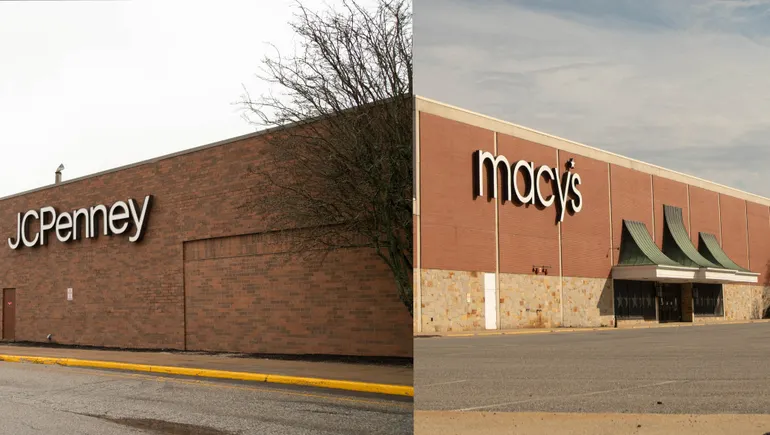
Amid ongoing pressure in the department store sector, two major U.S. department store retailers, Macy's and J.C. Penney, are adopting markedly different physical store strategies. Although both plan to improve store experiences and optimize supply chains, showing confidence that department stores remain viable as retail destinations, their paths diverge significantly in terms of store size, number, and location. Analysts point out that this difference is closely related to the current and potential ownership structures of the two companies.
The Trade-Off of Anchor Stores
For a long time, these two retailers have been core anchors of shopping malls, a model formed since the mid-20th century to drive foot traffic to malls. Now, Macy's is gradually breaking this tradition, while J.C. Penney remains committed to it.
Macy's Inc., under its Bloomingdale's and Macy's brands, continues to experiment with small-format stores about one-fifth the size of traditional downtown and mall anchor stores, located in strip centers. Last year, Macy's announced an acceleration of this small-store strategy, planning to open up to 30 small stores by fall 2025, which would triple the number of small stores, sometimes accompanied by closing full-line stores in the same market.
Macy's new CEO Tony Spring said at the Shoptalk conference in March that the company "operates too many stores built for a different era" and has "no choice" but to close some stores if it wants to thrive.
In contrast, J.C. Penney, acquired out of bankruptcy nearly four years ago by mall REITs Simon Property Group and Brookfield Properties, still maintains a close relationship with malls. Its transformation plan does not mention experimenting with small stores or entering strip centers, a stark contrast to Macy's approach.
Kevin McCrain, CEO of Brookfield Properties U.S., told Retail Dive: "I think their plan is very sound. They have a great leadership team that is taking them into the next phase of department stores. They are very focused, they know who their customer is, and they are committed to serving that customer, which is what every department store should strive to do."
The Choice to Open or Close
Another significant difference in the real estate strategies of Macy's and J.C. Penney lies in their considerations for adjusting store network scale. As of the most recent quarter, the Macy's brand operated 481 full-line stores, 12 small stores, and 9 Backstage off-price stores. According to financial reports released last week, J.C. Penney operated 663 stores.
Over a year ago, Macy's former CEO Jeff Gennette said that closing four full-line stores meant the company had essentially completed its plan, announced in 2020, to close about 125 underperforming stores. But this year, Spring said the company would close another 150 stores over the next three years. He also emphasized that even profitable stores would not be exempt from closure, a tough stance that analysts believe may be necessary in the long run.
Neil Saunders, Managing Director at GlobalData, noted that under normal circumstances, profitability is the main factor determining whether a store stays or goes, unless another location might generate higher sales or consolidation could improve efficiency. But he said via email that neither Macy's nor J.C. Penney is in a normal situation.
Saunders said: "It's no secret that Macy's has been in decline for a long time, and some stores may be experiencing continuous sales deterioration, so they may no longer be profitable in five or ten years. If Macy's acts now, it can address problems in advance and concentrate resources on stores it believes can drive the business forward. In a way, this is like amputating a gangrenous part: it's unpleasant and stems from past neglect, but it's necessary for survival."
Nick Egelanian, President of retail development firm SiteWorks, believes this approach balances profitability, capital costs, operating costs, and potential real estate value, and is "the right thing to do." He said: "Macy's needs to exit stores with no future and concentrate its limited resources on the most promising investments."
J.C. Penney's situation is quite different. During its 2020 bankruptcy, J.C. Penney had planned to close 144 stores, but that may have been the limit of its downsizing. Last week, Simon Property Group CEO David Simon told analysts that he does not "anticipate a lot of portfolio activity" for J.C. Penney, citing the chain's profitability and its importance to the communities it serves. He also said: "I don't necessarily believe in 'shrinking to grow,' which is hard to achieve." He believes the retailer might even benefit from expansion, because even many low-volume stores can be profitable (at least as measured by EBITDA). He said: "Penney can generate positive EBITDA even with low sales. In fact, I think Penney could almost be a beneficiary of opening new stores rather than closing them."
Both McCrain and David Simon have said that preserving local jobs was one of the factors in their companies' interest in acquiring J.C. Penney. But Egelanian is skeptical, arguing that Penney might also need to focus more on its best-performing stores. He said: "What matters is shareholder value, and what determines that value is profit and the hope or path to future profit. Therefore, JCP must focus on promising investments and exit businesses with no way out."
The Impact of Ownership
Analysts believe that the contrast in real estate strategies between Macy's and J.C. Penney is closely related to their ownership structures (with Macy's potential ownership in mind). Macy's is a public company accountable to stakeholders including investors, employees, and customers. J.C. Penney has been private since being acquired out of bankruptcy by Simon Property Group and Brookfield Asset Management four years ago, and brand management company Authentic Brands Group later acquired a 16.7% stake.
Erik Gordon, a professor at the University of Michigan's Ross School of Business, said via email: "Macy's is in the retail business, while Simon and Brookfield are in the mall business."
However, Macy's may soon also become a private company—if one of its investors, real estate-focused investment firm Arkhouse Management, gets its way. Arkhouse and its financial partner have bid $6.6 billion to acquire the retailer (including Bloomingdale's and Bluemercury). Since Arkhouse expressed its acquisition interest, Macy's has paid more attention to its property assets, strengthened the board's real estate expertise, and announced that property values will be a consideration when deciding which stores to close over the next three years.
Saunders said: "Because Macy's owns many of its stores, in some cases it may make more sense to monetize them and invest the proceeds in the business. For activist investors, that money could be used to generate returns rather than invest—but the principle is the same."
Meanwhile, J.C. Penney is owned by two landlords. Both Brookfield and Simon have invested in other retailers besides J.C. Penney, and analysts have long speculated that this is at least partly to prevent vacancies in their malls. Penney's value as an anchor is particularly prominent because vacant anchors often trigger clauses in other leases, leading to rent renegotiations or allowing other retailers to leave.
Gordon said: "Macy's doesn't own malls, it only does retail, so it will close marginal stores. Simon owns malls, so a marginal Penney store may be valuable enough to the mall business to keep it open."
Saunders also agreed that "the viability of the malls where J.C. Penney operates" depends on keeping stores open, and the success or failure of Penney stores can affect mall foot traffic, sales, and property values, while closures could disrupt other tenants. He said: "That would be highly undesirable, so the priority is to keep stores open for the benefit of the overall business. That said, I do think Simon has a genuine desire to make J.C. Penney operate better and remain profitable."