
Is Amazon's Disruption of Retail Coming to an End?
Amazon once disrupted retail with its customer-centric approach, convenient shopping, fast delivery, and low prices. But now, its market share growth has slowed, physical retail still dominates, and competitors have caught up. Under CEO Andy Jassy, Amazon is shrinking its physical stores, delaying warehouse construction, and laying off workers, while its Prime member satisfaction has declined. Experts point out that the competitive landscape of the retail world has changed, and Amazon's technological and efficiency advantages are no longer sufficient to win. Its true moat may lie in its ecosystem beyond retail, such as advertising and cloud services.
For a quarter of a century, Amazon has forced retailers of all kinds to innovate, speed up, and compete. The company built its disruptive power on an extreme focus on customers—simplifying shopping and payment processes, compressing delivery times to two days or less, and driving prices down sharply.
Yet, the e-commerce giant's impact on retail seems to be waning in some ways. Competitors like Walmart and Target have caught up significantly, strengthening their e-commerce operations and leveraging their vast store networks. Independent retailers, including independent bookstores that initially saw Amazon as a new rival, have also survived. Although Amazon still dominates online sales in the U.S., holding about 40% of the market per eMarketer data, physical stores still account for 85% of all retail sales, according to the U.S. Department of Commerce. E-commerce also remains an expensive way to sell, and Amazon is no exception—the company warned last month that holiday quarter profits could disappear.
In fact, after surging during the pandemic, Amazon's retail business has struggled throughout the year and appears to be reviewing its operations. Under new CEO Andy Jassy, the company this year closed most of its non-grocery physical stores and canceled or delayed dozens of warehouse projects originally planned for massive capacity expansion.
Recently, Jassy has been leading large-scale layoffs and hiring freezes, most of which involve the retail business. He is said to be reviewing underperforming business units, such as the voice assistant Alexa—which reportedly has failed to generate the expected order volume from users. Founder Jeff Bezos, before stepping down as CEO last year, wrote annual letters to investors promising the company was still in "Day One"; facing the current situation, he might view this new era as "Day Two."
Amazon now, like other retailers, is grappling with the challenges of retail's ongoing evolution. In the view of Doug Stephens, author of "Resurrecting Retail: The Future of Business in a Post-Pandemic World," Amazon's technological prowess and its focus on speed and efficiency are no longer enough to win in the industry.
"Not only has the retail world closed the gap with Amazon, but the very nature of e-commerce has fundamentally changed," Stephens said in an email. "More and more, retail no longer exists on static, boring, search-based websites like Amazon.com. It now lives in engaging, entertaining, and immersive content and interest communities. And these are areas where Amazon has never been strong."
Customers
Amazon has made itself indispensable to many consumers, most notably those who pay $140 a year for Prime membership. Members enjoy delivery as fast as next-day in some areas, along with benefits like streaming entertainment. But this powerful foundation has shown cracks.
According to Evercore analysts' research in June, Prime membership growth in the U.S. appears to have peaked, with penetration stagnating at 77% over the past two years. They said the company may have to look overseas for Prime growth.
More concerning to analysts are emerging signs of dissatisfaction. According to Evercore, Amazon remains the most-used retail website, with 94% of respondents saying they use it, the highest level in eight years. But analysts also found a recent decline in satisfaction, with 79% of Amazon customers saying they are "very satisfied" or "extremely satisfied." That is up from pandemic-era lows but well below the 88% in 2013.
Consulting firm Brooks Bell identified some of these issues. Nearly a third of respondents it surveyed earlier this year said they received delayed orders or lower-quality products from Amazon at least once a month. Meanwhile, 44% said items they wanted were out of stock at the "everything store," and 36% said they couldn't quickly find what they needed. Many consumers see better alternatives: nearly half of respondents said they would rather support small businesses than shop at Amazon, while 36% would go elsewhere for product expertise.
Evercore attributes the rising disappointment to "Amazon's aggressive expansion of its third-party marketplace to lower-quality international sellers, and its increasing placement of advertising inventory in product search results," as well as delivery delays.
Amazon declined to make anyone available for an interview for this article. But in an email, the company said it continues to "invest and prioritize creating the best customer retail experience," citing its October Prime Early Access Sale—which many called a second Prime Day event. The promotion generated an estimated $8 billion in gross merchandise value, 25% less than July's Prime Day, and below expectations. Amazon also said it just held its "biggest holiday shopping weekend ever" on Black Friday and Cyber Monday, though it has not yet released specific figures.
Competition
For years, most retailers have had to contend with fierce competition from Amazon, and their efforts have paid off.
Walmart has borrowed many of Amazon's ideas, such as launching the Walmart+ membership program offering fast delivery and other perks, cultivating a third-party marketplace, and building an advertising business.
"They took a long time, but Walmart is now essentially copying Amazon's playbook," Rick Watson, founder and CEO of RMW Commerce Consulting, said in a phone call. "The only thing they haven't copied is AWS, which they can't do. But advertising, fulfillment, marketplace—these all come straight from Amazon's playbook. They haven't really done anything unique. Their answer was to wait and see what works for Amazon and then copy it. And, it looks like it's working for them; they're more profitable now."
AWS is Amazon's cloud services division, a thriving technology business with numerous government and corporate clients, and its profitability has consistently been higher than the retail business.
Retailers have responded to demands for faster delivery and convenient online shopping—Target, for example, acquired the delivery service Shipt in 2017 to boost omnichannel offerings and developed its own app. But they have also embraced their traditional strengths. Walmart, Target, and other chains use their stores for fulfillment and pickup, an area where Amazon has less advantage, as its stores are mainly Whole Foods.
"Target has found its own path," Watson said. "Everything runs through their stores. I've always been impressed with what they've done, trying not to imitate Amazon."
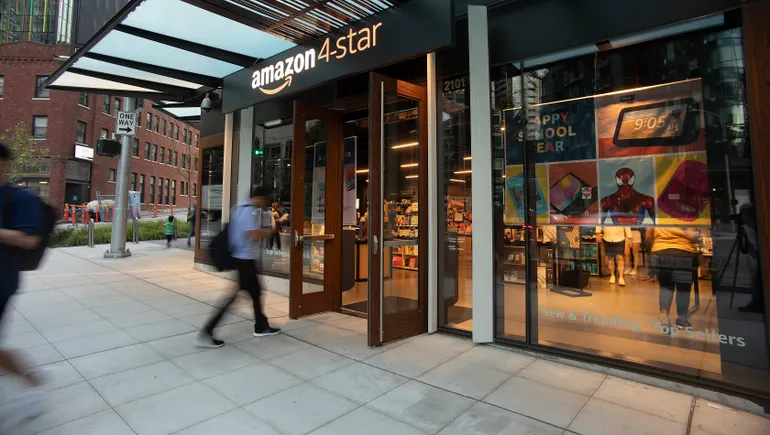
Physical stores themselves are a differentiator, with Target and other retailers investing in store renovations, differentiated merchandise, and excellent face-to-face customer service. Independent booksellers—operating in the retail segment Amazon first entered—have mostly survived, showing that a preference for local shopping can outweigh Amazon's convenience and pricing strategies. Indeed, Amazon has scaled back its non-grocery physical store business, closing all its bookstores and 4-star stores earlier this year.
"Clearly, in categories like bookstores, most of these stores lacked innovative elements or the ability to drive in-store engagement and experience," Rabia Yasmeen, senior consultant at Euromonitor International, said in an email. "Even its grocery stores... focus on payment capability, cashierless or self-checkout—there is still room to integrate online operations with physical presence."
Amazon said in an email that despite closing stores, it remains "committed to building great, long-term physical retail experiences and technology." The company opened several clothing stores this year, although The Guardian said in July that the Los Angeles location "misses the point of shopping." Watson believes they may serve as effective testing grounds and showrooms for its technology—including AI-driven recommendations and smart fitting rooms—but are "terrible" places to sell clothes.
However, competitors' strength does not come solely from the physical realm. This Black Friday, Walmart, Target, and Kohl's all surpassed Amazon in online deal searches, knocking the e-commerce giant from the top spot, although Amazon maintained the number one position on Cyber Monday, according to Capitfy.
Is it even retail anymore?
Several experts interviewed for this article pushed back on the notion that Amazon's disruption of retail is coming to an end.
"Many people look at Amazon's current state and forget that every step they've taken over the past 20 years to win customer business never had an immediate impact on their profits," Brendan Witcher, principal analyst at Forrester, said in an email. "Amazon has been gradually building an ecosystem connected to our lives that will help them sell to us better. In this strategy, the most impactful disruptions are almost imperceptible or hard to compete with until it's too late."
Indeed, unlike when it launched as a book e-tailer in 1994, most of Amazon's growth and profits now come from businesses beyond selling products. These revenue streams include advertising, third-party seller fees, subscriptions, and cloud services. Last year, Amazon disclosed its advertising revenue for the first time, earning $31.2 billion from selling ads that appear on its streaming, gaming, entertainment, and retail websites. Additionally, nearly 60% of items sold on its site actually come from its third-party seller marketplace.
Stephens noted the company is also building businesses in healthcare, finance, insurance, and education.
"If they succeed, this would create a more profitable structure than simply pursuing an ever-larger retail market," he said. "Even a small share of the global healthcare market could quickly surpass the value and profitability of Amazon's retail enterprise."
According to Witcher, this proximity to consumers remains a concern for the industry.
"Amazon's true competitive advantage over Walmart and Target is not its retail capabilities (like how fast they can get products to us)," he said. "It's their ability to sell to us anywhere, anytime, as we digitize our lives through home, car, and mobile interactions."
Many retailers, including Hudson's Bay, Saks Fifth Avenue, and Macy's, have followed Amazon and Walmart in creating marketplaces, while others like Nordstrom have added revenue through advertising. But how far are retailers willing to deviate from retail—the business of selling goods to customers? And how willing are they to continue competing against a rival that can forgo profits in its retail operations?
For other analysts, Amazon's disruption of retail is only as extensive as retailers have allowed, leading them to pursue money-losing operations without the cushion of lucrative sidelines like cloud services or investor patience. Nick Egelanian, president of retail development firm SiteWorks, compared e-commerce to another non-store retail segment—catalog sales—which he said contributed 10.9% of retail sales in 1994, the year Amazon was founded.
"Amazon has disrupted retail no more than Sears and Spiegel did with their catalogs," he said in an email. "But e-commerce is unprofitable in its current model. While Amazon has been and remains an illusion of retail disruption, it has truly disrupted the mindset and priorities of those who analyze, operate, and invest in retail—and continues to do so."
