
MetaBirkin NFT Creator to Appeal Hermès Trademark Infringement Ruling
Mason Rothschild was found to have infringed Hermès' trademark rights by creating the MetaBirkin NFT collection and was ordered to pay compensation. His lawyer, Rhett Millsaps, stated that the evidence was insufficient and plans to appeal, sparking discussions about the boundaries between NFT art and trademark law.
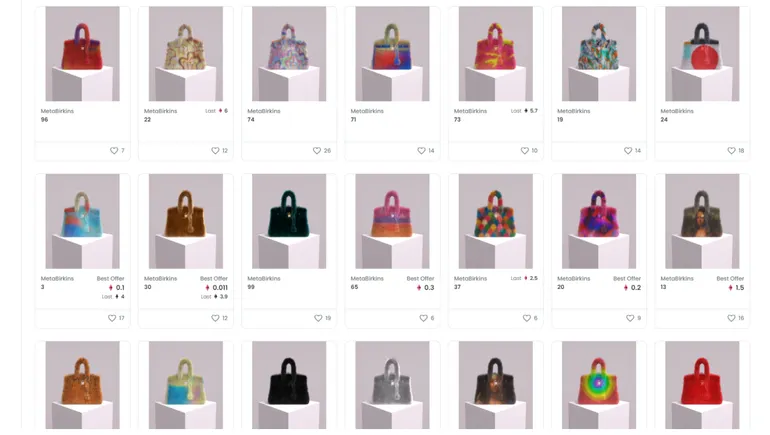
The artist who created a series of digital token artworks of fictional Birkin bags plans to appeal a jury verdict finding that the works, known as NFTs (non-fungible tokens), infringed trademarks held by Hermès. The Parisian fashion house filed the lawsuit a year ago, making it one of the first of its kind. The case has been widely seen as a test of trademark law, the relationship between art and commerce in the metaverse, and the First Amendment of the U.S. Constitution.
The creator of "MetaBirkins" is Mason Rothschild, founder of Gasoline XYZ, a company that describes itself as a "disruptive creative studio focused on web3 solutions," and co-founder of the fashion boutique Terminal, which has locations in Los Angeles and Tokyo. In an Instagram post, he promised that "this fight is far from over."
On Wednesday, a jury in federal court in Manhattan found Rothschild liable for trademark infringement, trademark dilution, and cybersquatting, and determined that the First Amendment did not protect him. According to court documents from the U.S. District Court for the Southern District of New York, the verdict carries financial consequences, including $23,000 in damages for cybersquatting, as well as $110,000 in net profits that Rothschild must return to Hermès. Cybersquatting involves the bad-faith use of another's trademark as a domain name. The MetaBirkins website remains accessible.
In a post shared on Instagram (link preserved), Rothschild showed that he is committed to continuing the fight.
However, Rothschild's lawyer, Rhett Millsaps, founder of the law firm Lex Lumina, said that the digital and tokenized nature of Rothschild's works, along with the discussions surrounding the metaverse, may have been a source of confusion for the non-expert jurors, and therefore the verdict is unlikely to be upheld on appeal. He said by phone that there was no evidence that any consumer—whether of NFTs or handbags—confused Hermès with Rothschild, partly because Rothschild explicitly presented the works as his own paintings and provided disclaimers stating they were not affiliated with Hermès.
"In this case, Hermès' evidence of confusion was extremely weak and fell far short of the legal threshold, especially in cases involving art and the First Amendment," he said by phone. "Trademark law allows Hermès to prevent others from selling products that compete with Hermès products, including in the metaverse. They can prevent others from selling NFTs that compete with their actual products in the metaverse, but they cannot prevent artists from selling artworks depicting their products, just as in the real world."
Hermès did not immediately respond to a request for comment. In the opening paragraphs of its complaint, the luxury group stated that Rothschild himself had declared that "nothing is more iconic than the Hermès Birkin bag."
Hermès' lawyers stated in court filings: "(Rothschild) is a digital speculator seeking to get rich quick by appropriating the METABIRKINS mark to create, market, sell, and facilitate transactions in digital assets called non-fungible tokens (NFTs). Defendant's METABIRKINS mark merely appropriates Hermès' famous BIRKIN mark by adding the generic prefix 'meta'."
The collection of 100 MetaBirkins debuted at Art Basel Miami Beach in 2021 and was not Rothschild's first adaptation of the Birkin bag. Previously, he had created "Baby Birkin," described on the page of the exclusive online marketplace BasicSpace as "NFT artwork created by Mason Rothschild and Eric Ramirez." That tokenized work was promoted as a "satirical tribute to the iconic handbag," a 2000x2000 pixel, 3D max animation with a soundtrack depicting a transparent "pregnant" Birkin with a fetus visible inside. The work sold for $47,000 at a BasicSpace auction in May 2021.
Rothschild then launched his 100 MetaBirkins project and sold each image for the cryptocurrency equivalent of $450 each. The works increased in value on the secondary market, much like the Birkin bag itself. In the retail market, these handbags, known for being difficult to obtain, sell for thousands of dollars and command even higher prices on resale. Some have even argued that they are a better investment than gold.
Hermès may view these similarities as evidence that Rothschild merely replicated its handbags in the metaverse for commercial purposes, but Millsaps said these similarities are key to the artistic nature of the project. In a report submitted to the court, art critic Blake Gopnik (who has written books about Andy Warhol) argued that "the images and NFTs that Mason Rothschild made and sold fall naturally and obviously within the scope of artistic experiments conducted by modern artists over the past century."
This week on Twitter, Gopnik, who was barred by the judge from testifying as an expert witness, expressed displeasure with Wednesday's verdict. "So artists are not allowed to take luxury goods as their subject matter and say so clearly in the title?" he wrote in a tweet.
Insane: Hermès, the luxury company, won $133,000 from little guy Mason Rothschild for making digital images of Birkin bags as NFTs that pissed them off. So artists are not allowed to take luxury goods as their subject matter and say so clearly in the title?https://t.co/Ar2AnMvKDV
— Blake Gopnik (@BlakeGopnik) February 8, 2023
However, lawyer Alan Behr, chair of the fashion and luxury practice at the law firm Phillips Nizer, dismissed the comparison to Warhol. He likened Rothschild's NFTs to screenshots of Birkin bags and said the works lacked sufficient political or artistic statements to distinguish them from the Birkin trademark and thus qualify for First Amendment protection.
"If it's art, the First Amendment and copyright issues prevail. If it's commerce, those protections disappear. In effect, what the court said is that this is commerce," he said by phone. "You can't take someone else's original expression for your own purposes; at some point, you have to pay the price."
Behr also said that the ruling upholding Hermès' trademark on the Birkin bag serves as a reminder that existing copyright and trademark laws apply to new technologies.
"I hope this marks the end of NFTs being used as an excuse for the latest digital misbehavior," he said. "Many people expected that they had new licenses and that previously applicable rules no longer applied. But that's not the case. New technology is just a new way of presenting things graphically, verbally, or visually, and the law applies to whatever medium you use."
But according to Millsaps, new technology should not prevent the existence or sale of artworks, nor does it preclude First Amendment protection for artistic expression. In its instructions to the jury, the court itself noted that "MetaBirkins NFTs, including the associated images, are, at least in some respects, works of artistic expression, for example, by adding full-body fur covering to the Birkin bag images."
Millsaps said Rothschild's imagination of "Birkin bags covered in this ridiculous fur" is an example of art in the traditional sense, just like any painting, photograph, or sketch. But digitization and tokenization allow creators to mimic the financial trajectory of real Birkin bags in a way that is also artistically valuable.
"It works as art and artistic experimentation, both in how it was released and in its existence linked to NFTs," he said. "The real question is: will this emerging metaverse just be a shopping mall, or will it reflect the real world, allowing artists to draw pictures of Birkin bags or any other object they see, and sell those drawings?"