
Sweetwater Achieves Record Sales Year with YouTubers and Podcast Creators
Music equipment e-commerce company Sweetwater achieved sales of $1.57 billion in 2022, a year-over-year increase of 9.5%, marking its third consecutive year exceeding $1 billion. Company President Mike Clem stated that the live streaming and podcast boom driven by the pandemic, government stimulus checks, and home creation demand fueled growth. Sweetwater insists on not expanding physical stores, focusing on consultative sales and customer service, and has newly opened a second-hand market and an Arizona distribution center.
Music equipment e-commerce retailer Sweetwater hit another high note in sales in 2022.
The privately held company said its sales reached $1.57 billion, a 9.5% increase year over year. Fort Wayne, Indiana-based Sweetwater has now reported sales of more than $1 billion for the third consecutive year.
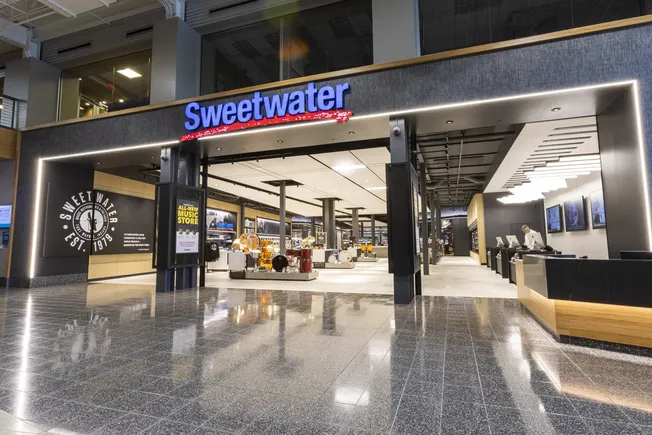
Unlike competitors Guitar Center, which opened its 300th store last month, and Sam Ash Music, which has a smaller physical footprint of fewer than 50 stores, Sweetwater has just one showroom and retail store in Indiana, which places it squarely in the DTC (direct-to-consumer) space.
Guitar Center and Sam Ash also operate e-commerce stores for new and used gear. Another competitor, zZounds, used to have physical stores but now also operates via e-commerce only.
In 2021, Sweetwater's sales reached $1.43 billion, a 25% increase year over year. The company first reported revenue of $1 billion in 2020 and said it served more than 1.5 million unique customers. Sweetwater declined to provide specific profit figures.
Like almost every other industry, the pandemic hit musicians of all kinds hard. When live music shut down, people had to find new sources of income, and some found it through livestreaming.
"The equipment needed to play live music is different from what's needed to build a recording studio," said Sweetwater President Mike Clem. That shift drove some of the company's growth.
He also said several rounds of stimulus checks helped. With lockdowns, quarantines, mandatory work-from-home arrangements, and virtual learning schedules, people had extra money and time to invest in their hobbies or passions or try something new.
As the pandemic receded, Clem said musicians and creators realized they could be active in both livestreaming and live performance. "So in a way, the pandemic actually accelerated the industry and created entirely new revenue streams for musicians," Clem said.
Clayton Durant, founder of CAD Management, a music management and entertainment consulting firm, noted that artists, songwriters, producers, podcast hosts, and creators are investing more than ever in home recording studios and creative equipment. Durant is also an adjunct professor at Long Island University's Roc Nation School of Music, Sports & Entertainment.
"From a music standpoint, you can validate this underlying equipment demand by the fact that streaming services like Spotify add more than 100,000 new songs daily," Durant said.
Durant also noted that "companies like Sweetwater democratize the new and used gear market, enabling artists, songwriters, and producers to access the equipment and knowledge to build home studios that are nearly on par, technologically, with any professional studio on the market today."
Home studios have become ubiquitous and have mass appeal to all types of creators.
"Additionally, it would be remiss not to mention that Sweetwater has likely benefited from the rise of podcasting. According to a recent report from Triton Digital, there are currently about 5 million podcasts and over 70 million episodes available in the market," Durant said. "Similar to music, home equipment and software have made it easier than ever to launch a podcast."
"As the number of podcast creators grows, companies like Sweetwater have an entirely new set of equipment consumers who don't fall into the typical artist or creator category. I think podcasting is a key component of Sweetwater's continued growth and success," Durant said.
That's evident for Sweetwater, where a tab on its homepage invites people to shop by category, including guitars, drums, live sound & lighting, software, and content creators. Clicking that link leads to sub-links that further break down podcasting, streaming, and video categories.
Three years after the pandemic emerged, "live music is coming back strong," Clem said. "So a lot of our strength in recent months is actually coming from the return of those live music people — those venues, cruise ships, arenas." Clem said 2 million new customers have shopped at Sweetwater in the past three years.
The no-store strategy
Sweetwater has more than 10 million customers in its database. These customers range from young beginner musicians, to volunteer musicians or sound and lighting directors at churches, to hobbyists, live music venues of all types and sizes, and professional full-time performers.

Most of them will likely shop through the company's e-commerce platform. That's because Sweetwater currently has no plans at all to expand its physical retail footprint.
Instead, the company focuses on customer service through its trained workforce, such as its nearly 600 sales engineers. They have educational backgrounds or professional experience in the music industry. Clem said many have toured or worked in professional recording studios. Sales engineers undergo 13 weeks of product training.
Customers are matched with sales engineers who have similar interests, and "every time you interact with the company again, you get the same sales engineer." Clem explained that the goal is to build relationships over time that go beyond transactions.
Instead of expanding its physical retail business, Clem said, "we're more focused on this consultative sales model, being experts over the phone, email, text, wherever the customer is... So for us, it's very important to keep our sales team in one place so we can be the best experts in the industry."
Durant said Sweetwater's customer service approach is its "biggest competitive advantage."
"Ultimately, Sweetwater's brand positioning as a partner for creators is exactly why they don't need a physical store strategy. Having a large physical retail presence would likely not help them continue to be a partner to creators — especially when their customers are more global than ever," Durant said.
Pandemic impact and recent growth
If you listened to music or watched a live performance today, chances are you heard or saw one of the tens of thousands of products from the more than 350 manufacturers that Sweetwater carries.
The company currently has 35,496 SKUs. But like many other retailers in recent years, Sweetwater faced some supply chain-related challenges during the height of the pandemic and its aftermath.
Clem said the supply chain is still disrupted but recovering. Supply chain disruptions affected the company in two ways. First, many instruments, parts, and accessories are produced overseas. Second, guitars, one of the company's core products, were specifically impacted.
Guitar production slowed due to supply chain disruptions. "As the craftsmanship of these instruments has to maintain high standards, it really required a ramp-up," Clem said. "We're just getting back to a starting point where we feel better about 2023."
Clem also described the 2022 holiday season as a "strong" period for the company.
"Our industry has a lot of discounting like other categories," Clem said. With live music recovering strongly, "we've actually found some growth by serving that resurgence of music."

To address the post-pandemic resurgence of live music, Sweetwater launched a school band and orchestra e-commerce store in 2021; launched a used gear marketplace in summer 2022; and opened a new 350,000-square-foot distribution center in Arizona in the fall.
"We started shipping in October," Clem said of the Phoenix-area distribution center, "and it's growing very fast. It's significant for us because now we can ship to the West Coast in one to two days, whereas before it took four to five days."
The Arizona facility is the company's first expansion outside of Indiana. Clem said e-commerce activity on the website has improved now that customers know orders will arrive faster.
"Customers who might have abandoned their carts before are now converting because now we can deliver accessories in time," Clem said. "We can make it in time for the gig. It's been a huge success, and that's only going to grow this year as we scale up significantly before the holiday season."
Clem said the decision to expand into the band and orchestra space "was somewhat pandemic-driven because so many music stores went out of business." That left schools and smaller communities with few options to get the products they needed.
If you're looking for used gear, Sweetwater Gear Exchange allows customers to list their items for resale. When an item sells, sellers can choose to receive payment in the form of a Sweetwater gift card, thereby avoiding fees.
Entering the used market "is really going to be a big driver for us in 2023," Clem said.
Despite ongoing retail challenges, Clem said Sweetwater is confident in its current business strategy of diving deep into streaming and podcasting markets, providing excellent customer service, and not expanding its physical store footprint, which puts the company on a sustainable and successful path.