
Core Challenges Facing Gap Inc.'s New CEO and Path to Brand Revitalization
Since Art Peck's departure in 2019, the CEO position at Gap Inc. has seen frequent turnover, and leadership across its four major brands has been unstable. The new CEO, Richard Dickson, will assume office next week, with a background primarily in the toy industry and lacking apparel experience. Industry opinions are divided, but there is general consensus that his innovative thinking and brand reinvention capabilities are key. This article examines the current state of Old Navy, Banana Republic, Athleta, and Gap one by one, highlighting the challenges and potential opportunities each faces.
Since Art Peck's abrupt departure in late 2019, Gap Inc. has had more interim CEOs than permanent ones, while leadership across its four main brands—namesake Gap, Old Navy, Banana Republic, and Athleta—has also seen multiple changes. Next week, another new chief executive will take the helm.
Richard Dickson just successfully revitalized the Barbie brand, but has limited experience in apparel. Whether he can ultimately turn around the struggling San Francisco-based conglomerate remains unclear. Although he has been on Gap Inc.'s board for months and once led brand operations at Jones Apparel Group for four years, most of his career was spent at toy maker Mattel, from which he stepped down as chief operating officer only this month.
"I know a lot of people are skeptical or confused about this. But I think thinking outside the box and finding someone who has revived iconic brands in a fun and relevant way isn't a bad thing—Barbie is a case in point," Lee Peterson, executive vice president at WD Partners, said on a call. "He could potentially do the same for the Gap brand. But someone has to be in charge of the merchandising that goes with it."
Dickson's apparel experience may not be extensive, but according to Liza Amlani, principal and co-founder of Retail Strategy Group, his focus on innovation and the customer is exactly what Gap Inc. needs.
"I really admire how he talks about wholesale, retail, e-commerce, and omnichannel, as well as innovation and the customer," she said on a call. "The fashion industry is fickle—if you don't know what the customer is looking for and why they came to you in the first place, you're in trouble. He can bring a strategic perspective through all his experience, including at Mattel. That's what excites me, because I think the consumer's voice has been missing at Gap Inc. for years."
Additionally, Simeon Siegel, managing director at BMO Capital Markets, noted that the overlap between toys and apparel may be greater than many realize. Both are highly discretionary purchases with seasonal fluctuations that require a high level of marketing capability.
"The similarities between toys and apparel are greater than they appear on the surface."
Simeon Siegel, managing director at BMO Capital Markets
"Both require appealing products, but equally important, they need a compelling story," he said. "So the similarities between toys and apparel are greater than they appear on the surface. For the Mattel business, the toy business, understanding the brand and protecting the brand is crucial. Therefore, there's likely an easy baton pass between these two industries."
Some in the industry welcome the fact that Dickson brings operational strength from companies like Mattel rather than apparel sourcing skills.
"I'm glad they didn't pick a 'merchant.'" Jeffrey Sward, founding partner and CEO of Merchandising Metrics, said in an email. "Gap performs best when product and marketing are both fairly straightforward. If they can activate both product and marketing, they can become a force again. The CEO's job is not to be the chief buyer for every business. His job is to create a business model that demands both a great story and profitability."
Still, the pressure is on Dickson, and Mark Cohen, director of retail studies at Columbia Business School and a company veteran, said entrusting Gap Inc.'s turnaround to him requires a leap of faith. Gap Inc. and each of its brands need a "fundamental repositioning," along with new strategies around product, design, sourcing, pricing, and presentation.
"This company is in trouble for absolutely no other reason than a severe lack of leadership. If he can provide that leadership and build strong teams for these iconic brands, especially Gap, he could succeed."
Here's what Richard Dickson is facing across the four brands.
Old Navy
Gap Inc.'s discount brand Old Navy, founded in 1994, was the first in the group to reach $1 billion in sales and quickly became the company's engine. According to BMO's Siegel, among single-brand specialty retailers, Old Navy generated $8.2 billion in sales last year, making it the second-largest apparel seller in North America, behind only Nike.
"Old Navy's ability to put their name on a massive amount of low-priced products and sell them is a skill."
Simeon Siegel, managing director at BMO Capital Markets
"This is a massive business that defies all odds in single-brand specialty apparel," he said. "They created a low-price brand, which is hard to do because it's not easy to advertise cheap. They overcame the stigma. Old Navy was able to put their name on a massive amount of low-priced products and sell them. That's skill."
But Old Navy has been in turmoil in recent years, with leadership changes and growth sometimes reversing. According to Amlani, from a merchandising standpoint, there are too many products and a lack of true identity.
Siegel said it may also be time to question whether it has peaked.
"It might be worth determining whether there's really still domestic growth space, or whether it's time to focus on driving profit and generating cash," he said. "Because the business is so large, but it's still a brand, and brands reach saturation points."
Banana Republic
A few years ago, amid declining sales and the rise of more casual workwear, many had written off Banana Republic. But the brand remains a busy business and has recently shown new vitality through merchandising and marketing overhauls.
"Banana Republic as a standalone entity would be one of the largest apparel brands by any measure. But because it's consolidated with the rest of Gap Inc., it often gets overlooked," Siegel said, though he noted the company does not disclose profitability by brand.
However, the brand's apparel and marketing campaigns have emerged from the "boring middle," something its sister brand Gap also must do, Sward said. "I loved what they did a year ago," he said. "I think recently they've gotten a bit too refined, and the numbers show that."
Banana Republic is primarily a menswear brand, and its womenswear offerings need attention, Amlani said, adding that its forays into baby clothing and home goods are unhelpful distractions.
Athleta
With Old Navy somewhat in decline, Banana Republic in mid-transition, and the namesake Gap brand struggling for years, Gap Inc. has in recent years pinned its growth hopes on the Athleta activewear brand. Last year, the company maintained its target of $2 billion in annual sales for Athleta, with some analysts considering a spinoff. But in the most recent quarter, Athleta's net sales fell 11% to $321 million, with comparable sales down 13%.
Disappointment has already set in, and the brand welcomed another new CEO in the same week as Dickson's appointment—Alo Yoga's Chris Blakeslee. But according to BMO's Siegel, like the strengths of Old Navy and Banana Republic, Athleta's achievements are too easily overlooked.
"Athleta was touted as the savior, which may have hurt its narrative because it was just under $1 billion in sales pre-pandemic and now it's at $1.5 billion," he said. "To be fair, the business has stalled and is declining, so they do need to fix that. But how we judge retailers may affect perceptions of their success more than their actual performance. All in all, this is a $1.5 billion excellent business."
Comparing Athleta to DTC brands like Lululemon or Alo Yoga is unfair because the brand offers a broader range of price points and sizes to appeal to a wider audience, financial and merchandising analysts said. In fact, Amlani believes Athleta itself may be trying to do too much.
"Athleta is not innovative at all," she said on a call. "I think they're almost too content to take inspiration from Lululemon or Nike. There's nothing truly new at Athleta. So bringing in new people for Athleta, and then the entire Gap Inc. organization—I think that's when we'll really start to see what each brand stands for."
Gap
The company's namesake brand also has strengths, though much of that strength is in the past.
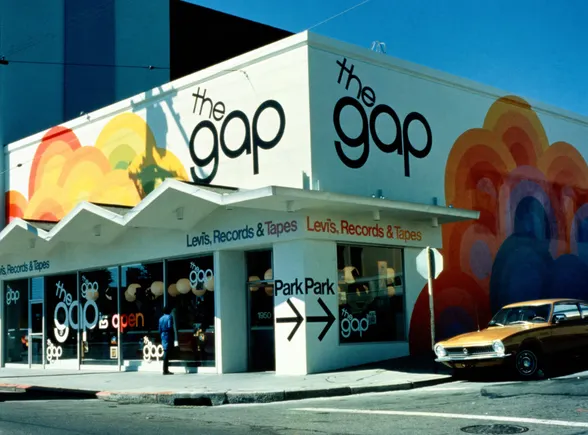
Founded in 1969, Gap started as a single store in San Francisco selling Levi's and styles and fashions not found in department stores. It eventually evolved into its own brand, primarily selling basics—jeans, khakis, T-shirts, sweaters, and sweatshirts—with an aura that relied on a series of brilliant marketing campaigns and successful collaborations.

With one notable exception—the failed "Yeezy Gap" collaboration with Ye (formerly Kanye West)—the brand has continued to find success with some collaborations, experts said. These include the partnership with Dapper Dan, which made people crave its sweatshirts again, and more recently with LoveShackFancy.
However, Gap's marketing no longer resonates, a huge fall for a brand that once confidently featured icons like Miles Davis, Marilyn Monroe, and Louis Prima, as well as celebrities from all walks of life, in its campaigns. Multiple analysts said Gap's merchandising missteps, quality decline, and tendency to discount also suggest it has lost touch with its customers.
"Gap brand revenue has been declining for over a decade, possibly approaching two decades, and Gap has been on the defensive for a long time," Siegel said, noting that promotions and inferior quality are often attempts to salvage revenue and protect profit but end up damaging brand quality.
"At the end of the day, both are examples of forcing revenue," he said. "Both are attempts to save today at the expense of tomorrow."
Overall, experts said the brand has lost its magic, which may be a different project for Dickson than the one he had at Mattel. Mark Breitbard, a longtime Gap Inc. executive, has been in charge of the brand for the past three years.
"It needs a better merchandise mix. Each attempt at improvement has been worse than the last, and now the original styles are sold at Target for less," Paula Rosenblum, co-founder and managing partner of RSR Research, said in an email. "I really don't know what Gap stands for. And Barbie, we know."