
New Developments in the TikTok Ban: How It Differs from Before and How Marketers Should Respond
The U.S. House of Representatives passed the Protecting Americans from Foreign Adversary Controlled Applications Act by a vote of 352-65, requiring TikTok to divest within 165 days or face a ban. Compared to 2020, this ban attempt appears more severe due to congressional support, presidential statements, and a broader social context. Marketing experts advise brands to prepare contingency plans in advance, with budgets potentially shifting to Instagram Reels and YouTube Shorts.
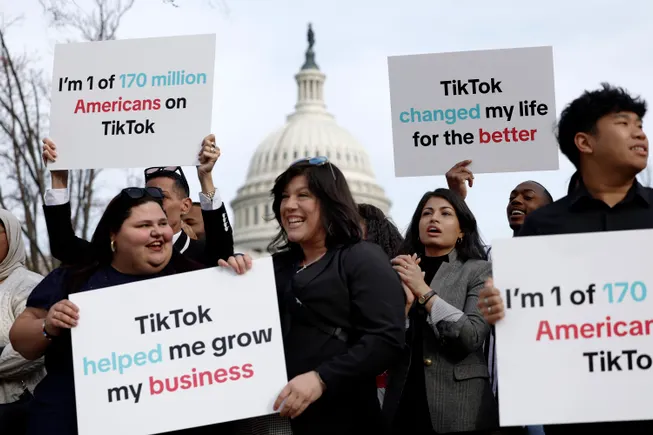
TikTok is once again in the spotlight—though it never really left—now facing the threat of a nationwide ban in the U.S., with a proposal submitted to the Senate. The bill requires TikTok to sell its business if it wants to continue operating in the U.S., raising questions about how the evolving social media landscape affects TikTok's fate and what impact marketers might see.
The latest bill targeting TikTok comes as the ByteDance-owned platform continues to raise national security concerns over its Chinese ownership and how it handles U.S. data. The bill, named the Protecting Americans from Foreign Adversary Controlled Applications Act, passed the House overwhelmingly last week with a 352-65 vote and has now been sent to the Senate. If the bill moves forward, President Joe Biden has said he would sign it into law, giving TikTok 165 days to sell or face a ban in the U.S.
"The overwhelming support in the House and the move to the Senate, along with Biden's stated support, makes this attempt feel more real—but it's still not time to panic," said Ed East, co-founder and group CEO of Billion Dollar Boy, in an email comment. East noted that given the Senate's decision is still pending, and TikTok would have time to sell if the bill becomes law, he ultimately doesn't think a full ban will take effect.
Although the Senate has also indicated there will be some breathing room before making a decision, questions naturally arise: how is this ban attempt different, who might benefit, and where could social media ad spending potentially flow.
A 'perfect storm' forms
TikTok has repeatedly found itself in political turmoil since entering Western markets—the app is already banned on most U.S. government devices—but aside from the current situation, perhaps the most serious threat to its existence came in 2020 under former President Donald Trump, who attempted to ban the app through an executive order that was later rescinded. At that time, several entities interested in acquiring the app emerged, including Microsoft, Walmart, and Texas-based tech company Oracle, which now helps store U.S. TikTok user data. Trump has since changed his stance, opposing the current ban push.
Although the latest ban attempt is similar in some ways to past ones, the key difference in the current debate is the passage of time, which has broadened awareness and perspectives on TikTok-related issues, said Mike Proulx, vice president and research director at Forrester. Since 2020, questions about social media's impact on mental health, misinformation, and child safety have increased, while consumer privacy concerns and antitrust legislation have reached a boiling point.
"All these factors together create a perfect storm where the government feels it needs to take some regulatory action on social media," Proulx said. "This has been brewing, and current conditions are ripe for escalated action."
There is no shortage of examples of the government's willingness to increase social media regulation. In January, a Senate hearing discussed apps including TikTok, Snap, Meta, and X (formerly Twitter) and their ability (or lack thereof) to keep children safe, with Republican Senator Thom Tillis of North Carolina telling top social executives: "If we wanted to, we could regulate you out of business." This paints a tense picture of Congress's current attitude toward platforms.
"The overwhelming support in the House and the move to the Senate, along with Biden's stated support, makes this attempt feel more real—but it's still not time to panic."
—Ed East, co-founder and group CEO of Billion Dollar Boy
Data protection has also become a widely discussed topic. In the U.S., TikTok has attempted to address concerns about its data practices through its billion-dollar U.S. data isolation project, "Project Texas." However, the Wall Street Journal reported in January, based on internal documents and accounts from current and former employees, that TikTok was still sharing U.S. user data with its Chinese parent company—something Project Texas was designed to prevent.
Beyond the social sphere itself, the broader economic landscape has also shifted. President Biden is more inclined than former President Trump to impose trade sanctions on China. In a push that could counter China's economic dominance, Washington is more likely to move forward with a TikTok ban if ByteDance refuses to sell.
Portrait of potential buyers
While whether the TikTok ban bill will pass remains a huge "if," even greater speculation surrounds whether ByteDance will agree to divest, and whether its highly acclaimed algorithm is included in the deal. In response to the news, TikTok issued a statement saying "the bill was forced through for one reason: it's a ban," and hopes the Senate will consider the facts and recognize the economic opportunities the app brings—claiming 170 million U.S. users and supporting 7 million small businesses.
Nevertheless, a few interested buyers have reportedly emerged, including Shark Tank star and businessman Kevin O'Leary, as well as former Activision CEO Bobby Kotick. After the House passed the bill last week, former Treasury Secretary Steven Mnuchin also announced the formation of an investor group to attempt to acquire the app. Mnuchin, who previously served as chairman of the U.S. Committee on Foreign Investment, is the founder of Liberty Strategic Capital, which has made several investments, including in cybersecurity companies, making the executive a strong potential buyer.
Whoever attempts to acquire TikTok will need substantial capital. The app is highly popular among younger audiences, with an internal valuation reportedly reaching $268 billion in December.
"If—and it's a big if—ByteDance decides to sell, momentum among potential buyers is already brewing because TikTok as an app has had an impact on the culture, society, demographics, creativity, and every aspect of daily life for nearly half of Americans," Proulx said.
During the 2020 ban attempt, potential TikTok buyers emerged for various reasons. Walmart wanted to boost its advertising business, while Oracle aimed to bolster its data services. In the years since, TikTok has matured into a giant, building a strong advertising business and expanding into areas like social commerce. As a result, potential buyer interest this time may take new forms.
"This conversation may be different from 2020, when it seemed like just a startup social network," said David Tiltman, senior vice president of content at WARC.
"What's the AI play around TikTok? I don't have the answer, but that question will be raised."
—David Tiltman, senior vice president of content at WARC
According to WARC Media data, U.S. ad spending on TikTok was estimated at $8.7 billion in 2023, and is expected to grow to $10.9 billion this year. By comparison, in 2020 and 2021, U.S. spending on TikTok was lower than on Snap. Tiltman noted that due to TikTok's broad growth, interested buyers might envision the app's future in multiple ways. Beyond potential interest in TikTok's existing businesses, such as e-commerce, he expects questions about the app's potential to combine with the current AI boom.
"What's the AI play around TikTok? I don't have the answer, but that question will be raised," Tiltman said.
Given the context of the latest ban attempt, any potential buyer must have credibility and a public image that represents consumer privacy rights, Proulx said.
"It has to be a third-party intermediary company that both the government and consumers trust as objective and honest, otherwise you're just trading one problem for another, or possibly even exacerbating existing issues," Proulx said.
Where ad spending could flow
Beyond regulation, social media has also changed dramatically since 2020. Meta's response to TikTok, Instagram Reels, launched in August of that year. Since then, some findings have shown that brand video content on Instagram Reels outperforms TikTok and Facebook.
If marketers shift budgets away from TikTok, Proulx believes funds will flow to Reels. In the context of government antitrust crackdowns, this could have adverse consequences.
"Meta will be the beneficiary of all this, and while that's good for Meta as a company, whether from a user or ad revenue perspective that could materially grow, it now deprives the market of competition," Proulx said.
Other competitors have also emerged, including YouTube Shorts, which YouTube has been working to monetize. Across platforms, North American advertisers plan to increase budgets on TikTok, YouTube, and Instagram in that order this year, according to WARC's recent Marketer's Toolkit survey, indicating the latter two are likely beneficiaries of any potential ban.
Nevertheless, any action against TikTok could throw marketers into some disarray—67% of U.S. business-to-consumer marketers report that their organizations plan to increase investment in TikTok this year, according to Forrester's 2024 marketing survey. With the decision on the app pending, Proulx suggests starting to plan around potential outcomes.
"Every marketer needs to have a contingency plan right now, and if they don't," Proulx said, "they're already behind."
