
6 of 12 Best-Selling Glutathione Supplements on Amazon Fail to Meet Label Claims, Cata-Kor Independent Testing Reveals Industry Quality Concerns
U.S. nutritional supplement company Cata-Kor released results of an independent testing study on glutathione supplements sold on Amazon. Of the 12 best-selling products purchased in April 2026, 6 failed to meet the glutathione content claimed on their labels, and two contained no detectable active ingredients. Testing was conducted by Swift Laboratory, which is ISO 17025:2017 certified, using standard HPLC analytical methods.
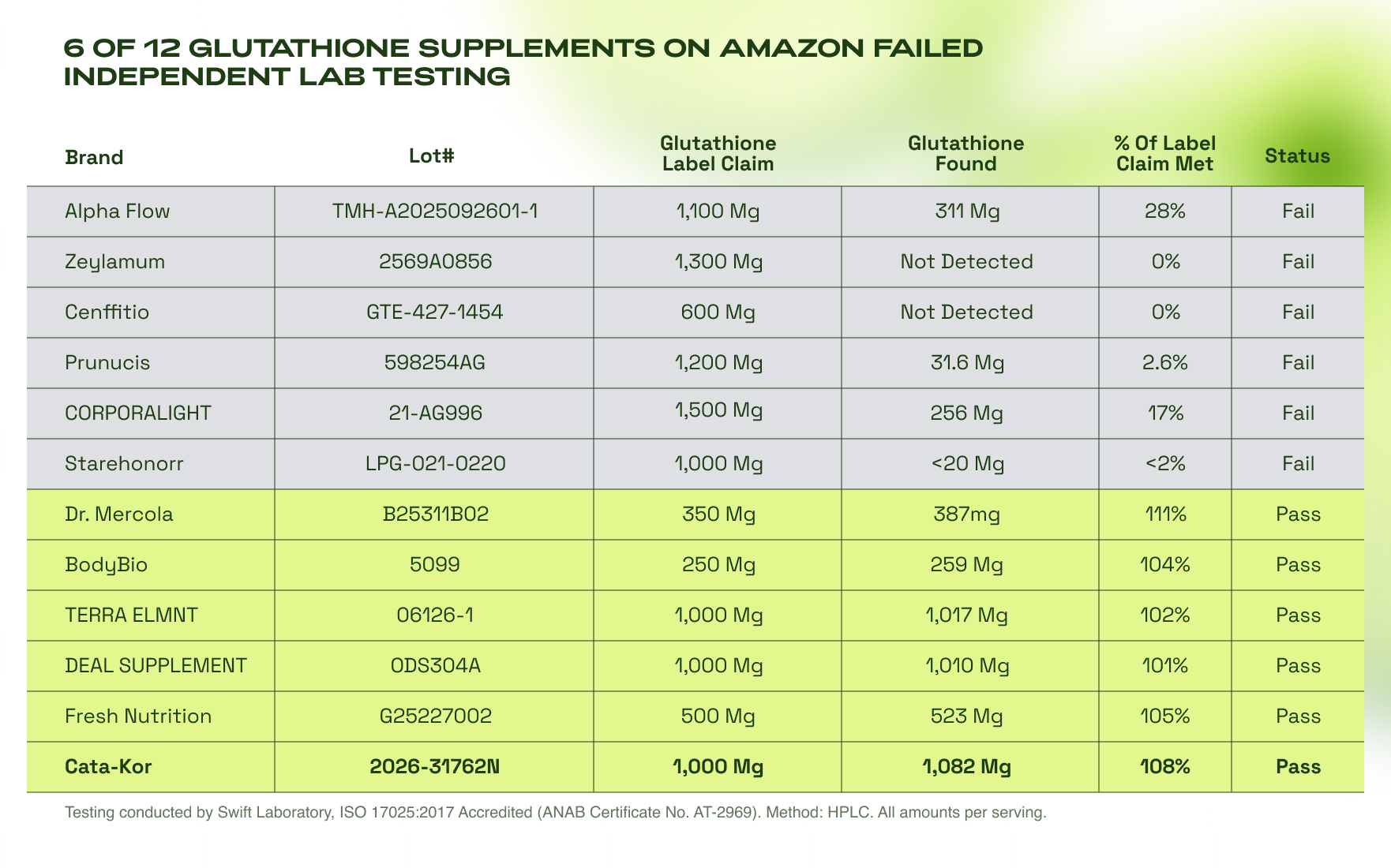

Cata-Kor, a U.S.-based nutraceutical company, recently released results of an independent test of glutathione supplements sold on Amazon. In April 2026, the company purchased 12 best-selling glutathione products from Amazon.com and sent them to a third-party laboratory for content analysis. The test results showed that 6 of the 12 tested products failed to meet the glutathione content stated on their labels.
The testing was conducted by Swift Laboratory, an ISO 17025:2017 accredited third-party testing facility (ANAB Certificate No. AT-2969), using HPLC (High-Performance Liquid Chromatography), the standard analytical method for quantifying reduced glutathione in dietary supplements.
This finding reveals a broader quality issue within the glutathione category on Amazon. In recent years, liposomal and high-dose glutathione products have proliferated on the platform, but they generally lack consistent, independent quality verification.
Testing Methodology
All tested products were purchased directly from Amazon.com between April and June 2026 and submitted to Swift Laboratory in Ontario, California, for independent analysis. Glutathione content was quantified using HPLC, based on the serving size stated on each product's label.
Key Findings
Of the 12 brands tested, 6 failed to contain the glutathione content stated on their labels, with significant variation in the degree of deviation:
- Zeylamum: Labeled at 1,300 mg of L-glutathione per serving, no glutathione was detected.
- Cenffitio: Labeled at 600 mg, no glutathione was detected either.
- Starehonorr: Labeled at 1,000 mg, actual detected amount was less than 20 mg, below 2% of the label claim.
- Prunucis: Labeled at 1,200 mg, actual detected amount was only 31.6 mg.
- CORPORALIGHT: Labeled at 1,500 mg, actual detected amount was 256 mg.
- Alpha Flow: Labeled at 1,100 mg, actual detected amount was only 311 mg, less than 30% of the label claim.
Meanwhile, 6 brands—Dr. Mercola, BodyBio, TERRA ELMNT, DEAL SUPPLEMENT, Fresh Nutrition, and Cata-Kor—met or exceeded their labeled glutathione content.
Cata-Kor's Own Product Passed All Tests
Cata-Kor's Liposomal Glutathione product passed all testing parameters. Swift Laboratory's independent analysis confirmed that the product actually contains 1,082 mg of L-glutathione complex per serving, exceeding its label claim of 1,000 mg. The same test also confirmed label accuracy for all co-ingredients: Vitamin C measured at 64.8 mg (labeled 50 mg), Riboflavin at 6.79 mg (labeled 5 mg), Selenium at 71.0 mcg (labeled 55 mcg), and Resveratrol at 114 mg (labeled 100 mg). Heavy metal testing also confirmed levels well below USP safety limits.
"Label accuracy is a basic expectation, not a competitive advantage," said Dr. Roman Miroedov, Head of Product Development at Cata-Kor. "When 6 out of 12 tested products fail to deliver on their label promises, that constitutes a consumer protection issue. We are publishing these results because consumers deserve to know what they are actually getting."
Cata-Kor is a U.S.-based nutraceutical company dedicated to developing formulations that support vitality, health, and daily performance. Cata-Kor has manufacturing facilities in the United States, with all testing conducted domestically, upholding a philosophy of transparency, quality, and science-driven development.
For more information, visit www.catakor.com
Roman Miroedov, PhD
Cata-Kor
[email protected]