
Retail Faces a Crime Problem: The Truth in the Data Fog
The issue of retail theft is often emphasized in industry reports and media coverage, but deeper analysis reveals problems such as ambiguous definitions, sample bias, and misuse in the relevant data. This article reviews the industry's major statistical sources, uncovering the complexity behind the data.
Any deep dive into the problem of retail theft reveals a clear issue: a lack of clear data on how severe the problem is, whether it is worsening, or even if it is truly getting worse.
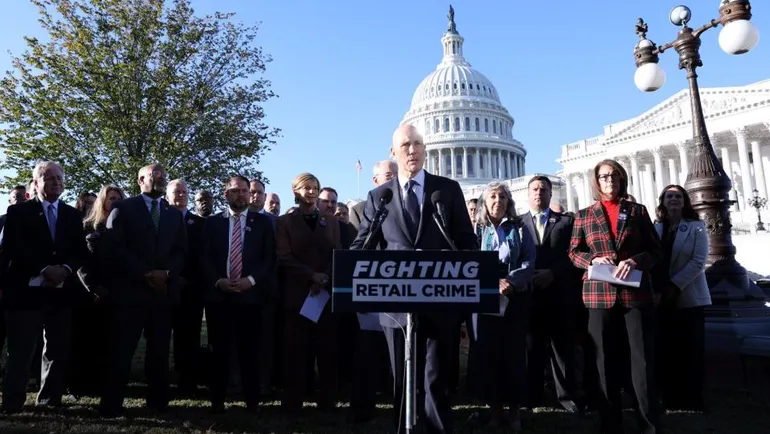
Nevertheless, the industry itself, as well as some retail chains, continue to emphasize the issue in research reports, earnings calls, and other forums. On October 26, representatives from the National Retail Federation (NRF) gathered on Capitol Hill for an event called "Combating Retail Crime Day," aimed at "advocating for legislative solutions to address organized retail crime."
Many cite high-profile reports of smash-and-grab robberies or arrests of organized thieves as evidence of the problem. In terms of statistics, journalists, lawmakers, and other business groups rely on data from the NRF and the Retail Industry Leaders Association (RILA). Meanwhile, some analysts argue that the retail industry may be exaggerating the problem to some extent.
"While theft may indeed be increasing, companies may also be using this as an opportunity to divert attention from margin headwinds stemming from recent higher promotional activity and weaker inventory management," said a team of William Blair analysts led by Dylan Carden in a client note on October 25. "We also believe that some permanent store closures recently attributed to shrink are actually related to the underperformance of those stores."
The issue is muddied by various uncertainties, especially because most of the discussion—whether in the media, the analyst community, or within the industry—conflates terms and figures.
What are we talking about?
Assessing the impact of retail crime on the industry is complicated by several terms that are poorly defined or used interchangeably.
In recent years, the NRF has annually published its "Retail Security Survey," billed as "the state of national retail security and organized retail crime." The study, based on surveys of dozens of retailers (the exact number varies by year), delves into inventory loss, known as "shrink."
That's where the problem begins. Shrink encompasses inventory loss from various causes, including theft, operational or process errors, and systemic errors. According to the NRF's annual Retail Security Survey, the retail shrink rate rose from 1.4% in 2021 to 1.6% in 2022.
The term "shrink" is often used by the media, researchers, and the industry as a synonym for "theft," even though, according to NRF data, more than a third of shrink stems from administrative causes unrelated to any form of theft.
The NRF itself is also imprecise on this issue. In its press release announcing the latest survey, the NRF described the entire dollar amount of shrink as a "retail crime" problem, even though retail crime is only a subset of total shrink.
Earlier this month, this error surfaced in New York. New York Governor Kathy Hochul vetoed a bipartisan bill that would have established an organized retail crime task force. In a public statement, the Retail Council of New York criticized the decision, noting that "stores investing in New York communities lost $4.4 billion to retail theft." Amanda Powers, a spokesperson for the council, said via email that the figure came from a Capital One Shopping report on retail theft that treated the NRF's total shrink figure as theft and extrapolated it by state.
However, based on how the Capital One report cited NRF statistics, the amount for all types of retail theft in New York should be $2.86 billion. Powers declined to comment on that possibility, saying the organization did not have additional relevant statistics to evaluate.
Shrink levels have not changed significantly for years
Shrink levels have remained relatively stable since at least 2015. To calculate the financial impact of shrink, the NRF uses the U.S. Commerce Department's revised estimates of total retail sales. In 2022, the NRF estimated shrink losses at $112.1 billion, up from $93.9 billion in 2021. These figures are not adjusted for inflation.
"Shrink is such a broad term that it's hard to parse what's behind the numbers. Of course, retailers mention it, but they're reluctant to share too many details," Neil Saunders, managing director of GlobalData, said via email.
Retailers focus on theft because, according to the NRF survey, about two-thirds of shrink—that is, unaccounted-for inventory—is estimated to be stolen, either by employees or external thieves. In 2022, employee theft accounted for 29% of shrink, while external theft—including shoplifting, cargo theft, and organized retail crime—accounted for 36%.
The biggest problem? Maybe, maybe not
The type of theft that the NRF and RILA focus on most is "organized retail crime" (ORC). The NRF defines it as "theft/fraud activity conducted with the purpose of converting illegally obtained merchandise, cash, goods, or cash equivalents into financial benefit (not for personal use), typically through online or offline sales."
Experts say this definition is neither legally binding nor precise, leading to inconsistencies in reporting by store employees, loss prevention personnel, and police. Like "shrink," the term "organized retail crime" is often conflated with other types of retail theft, including shoplifting, employee theft, and cargo theft. Because methods vary across local, state, and federal jurisdictions as well as among businesses themselves, law enforcement, prosecutors, legislators, criminologists, and retail loss prevention personnel do not define these terms consistently.
"It's a well-known problem in the industry that there are different interpretations of the definition of organized retail crime, and even within the same organization, different employees may interpret the same data differently," said Trevor Wagener, director of research and chief economist at the Computer & Communications Industry Association (CCIA), who studies these issues.
Moreover, the scale of organized retail crime may not be as clear as it once was. Today, according to the NRF and RILA, it is unclear what proportion of shrink is attributable to organized retail crime. But both organizations have attempted to measure it in the past.
In its 2020 report, the NRF said that "ORC costs retailers an average of $719,548 per $1 billion in sales," equivalent to 0.07% of sales. More recently, it has stopped publishing its impact separately. Today, the NRF still cites data when discussing organized retail crime, but it no longer releases specific financial costs for the issue.
Danielle Inman, senior director of media relations at the NRF, said via email that this is because retailers reported lower ORC losses than the NRF expected. She said the NRF believes "the reported dollar value of ORC may be just the tip of the iceberg and may significantly underestimate the problem."
Not all retailers survey ORC, some because they are less susceptible, but others may overlook the severity of the problem, Inman said. The NRF also said it no longer specifies dollar losses because the consequences of ORC are not all financial, noting that more than two-thirds of survey respondents said violence and assaults increased in 2022 compared to 2021.
However, some analysts believe the industry may be exaggerating the problem. S&P Global Ratings in September called retail theft "one of the biggest risks facing the industry," but its analyst team, led by Diya Iyer, also said, "we believe some retail companies may be exaggerating the impact of theft this year." Similarly, William Blair analysts speculated in a recent research note that some retailers may use theft as an excuse to mask issues of poor merchandising or poor store management.
"Shrink is such a broad term that it's hard to parse what's behind the numbers." — Neil Saunders, managing director of GlobalData
Most importantly, as a subset of retail theft (which itself is a subset of shrink), ORC has been difficult to quantify, said Wagener of CCIA. He said available data suggests that, overall, organized retail crime is not driving the increase in shrink.
"A deeper problem with ORC is that no one, not even retailers themselves, has a clear picture of the actual scale of the problem," he said. "I don't doubt that ORC patterns have increased in a limited number of stores in specific cities, but those stores don't seem to be representative."
The numbers come from within
This shows that, beyond the confusion of terms and lack of detail, the figures on shrink and theft are often outdated, inadequate, misinterpreted, or a combination of these. In turn, vague or inaccurate statistics are widely cited by the media.
First, industry reports on theft rely on surveys of a relatively small number of large retail chains. The NRF's Retail Security Survey and RILA's 2021 statistics on stolen merchandise rely on non-representative samples, which experts say casts doubt on their conclusions.
RILA's 2021 report on retail crime estimated that retailers lost up to $68.9 billion in stolen merchandise in 2019, a figure extrapolated from data from "five large, multistate retail companies."
Wagener of CCIA said five is too few to make such an extrapolation, and the fact that respondents were all large chains may also skew the results. Jason Brewer, senior executive vice president of communications and marketing at RILA, said the organization has not continued this line of research.
The NRF's annual shrink report includes data from more than five retailers, but it also relies on a relatively small sample. The organization's most recent calculation was based on survey responses from 177 retail brands. That is nearly three times the 63 respondents from the previous year, but it is still a small fraction of its membership of about 16,000 retailers.
The NRF's respondents collectively have annual retail sales of $1.6 trillion and operate more than 97,000 retail locations in the U.S. As with RILA's estimate, the retail theft experienced by these major players may not be representative of the entire industry, Wagener said.
Trent Buskirk, a professor of data science at Bowling Green State University and an expert in survey data, said the fact that the vast majority of members did not respond could also be a problem. "Non-respondents may have very different theft experiences, just that they didn't think it was worth reporting," he said in a phone call. "Non-response bias could inflate these statistics. When you see a figure like '70% of retailers,' that's a pretty high percentage, and everyone agrees. That kind of situation suggests the possibility of non-response bias."
The NRF did not directly respond to such criticism, only adding that about 35 respondents were retailers with fewer than 200 stores.
The power and weakness of numbers
The numbers produced by these surveys become further distorted when mislabeled or plugged into unsupported formulas.
For example, RILA's finding two years ago that $68.9 billion in merchandise was stolen annually has been particularly resilient. It is often cited as "nearly $70 billion" and still circulates in press releases, media reports, and white papers. The statistic, from a survey of five large retailers published in 2021, quickly gained attention and is often used to describe the scale of organized retail crime.
However, RILA's Brewer said via email that the finding refers to all theft, not just organized retail crime. In fact, RILA itself "generally no longer uses this figure in our communications because it is several years old," Brewer said. Nevertheless, RILA is still comfortable with the number because the report came from 2021 and its information was from 2019.
"I now always add the caveat that recent research suggests the number is now much higher, which aligns with benchmarking surveys we conduct with the asset protection community," Brewer said.
As Wagener previously noted, including in testimony to the U.S. Congress in June, the size and nature of RILA's sample make the figure questionable. Yet other credible sources have adopted it, often treating it solely as a measure of organized retail crime rather than all types of theft.
In 2021, the California Retailers Association used RILA's finding to argue that organized retail crime caused $3.6 billion in retail losses annually in the state. The Los Angeles Times noted that this was equivalent to 25% of the state's annual retail sales—which is unlikely or even impossible—especially given that the NRF estimated that year that organized retail theft averaged 0.07% of retail sales, "an amount about 330 times lower than the CRA's estimate."
Despite its questionable utility, the statistic is still cited authoritatively. U.S. Immigration and Customs Enforcement adopted it last year, and the Department of Homeland Security used it in its online information on combating organized retail crime. The U.S. Chamber of Commerce used RILA's report in its formula for calculating retail theft by state. Reuters included RILA's figure in its June explanatory story on retail crime.
"A deeper problem with ORC is that no one, not even retailers themselves, has a clear picture of the actual scale of the problem." — Trevor Wagener, chief economist at CCIA
In an email to Retail Dive, Brendan Dugan, president of the Coalition of Law Enforcement and Retail (CLEAR), pointed to RILA's figure as the latest reflection of "current retail losses to ORC," even though RILA describes it as all theft. Senator Chuck Grassley (R-Iowa) is among the most recent to publicly cite the figure, touting his meeting with the NRF in a late-October press release.
Wagener believes the NRF's data is imperfect but more credible than RILA's. However, in one case, the NRF inadvertently cited a wrong source, mischaracterizing an old NRF shrink figure as an estimate of ORC.
In a report this year focused specifically on organized retail crime, released jointly with risk, compliance, investigation, and monitoring company K2 Integrity, the NRF cited 2021 shrink as $94.5 billion, "with nearly half attributed to ORC, according to NRF survey data and research from the National Coalition of Law Enforcement."
This came from testimony by CLEAR's Dugan, who told the Senate Judiciary Committee in 2021 that the organization estimated organized retail crime costs retailers $45 billion annually. In an email to Retail Dive, Dugan confirmed he was citing the NRF's 2016 report on total shrink as CLEAR's ORC estimate.
This means that in the crime report released in 2021, the NRF used two different years' shrink totals, one as total shrink and the other as the ORC subset of that shrink. In fact, each figure reflects inventory loss from all causes, not adjusted for inflation, five years apart.
In an email, Mary McGinty, vice president of communications and public affairs at the NRF, said the NRF "was not aware that Ben Dugan cited any NRF report, research, or data in his 2021 Senate testimony" and "will review with K2 and, if necessary, correct and update the report."
She said "daily theft incidents" and "recovering millions of dollars in stolen retail merchandise" should remain the organization's focus. "We support the widely understood fact that organized retail crime is a serious issue affecting retailers and communities of all sizes across our country," she added. "At the same time, we recognize the challenges the retail industry and law enforcement face in collecting and analyzing accurate and consistent data to measure the number of incidents in communities across the country."
In fact, based on the NRF's own figures and methodology from earlier shrink reports, the inventory loss attributable to organized retail crime is far from the nearly 50% suggested by the NRF/K2 report, but rather close to 5%, Wagener found. All of this means...
